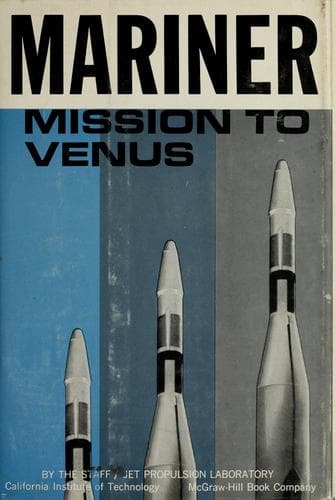
Mariner Mission to VenusJet Propulsion Laboratory (U.S.)
Science
Mariner Mission to Venus
Jet Propulsion Laboratory (U.S.)
Project Mariner (U.S.)
The spacecraft was allowed a pointing error of 1 degree in order to
conserve gas. The system kept the spacecraft swinging through this 1
degree of arc approximately once each 60 minutes. As it neared the limit
on either side, the jets fired for approximately ¹/₅₀ of a second to
start the swing slowly in the other direction. Thus, Mariner rocked
leisurely back and forth throughout its 4-month trip.
Sensitive photomultiplier tubes or electric eyes in the Earth sensor,
mounted on the directional antenna, activated the gas jets to roll the
spacecraft about the already fixed long axis in order to face the
antenna toward the Earth. When the Earth was “acquired,” the antenna
would then necessarily be oriented in the proper direction. If telemetry
revealed that Mariner had accidentally fixed on the Moon, over-ride
radio commands from the Earth could restart the orientation sequence.
PROPULSION SYSTEM
The Mariner propulsion system for midcourse trajectory correction
employed a rocket engine that weighed 37 pounds with fuel and a nitrogen
pressure system, and developed 50 pounds of thrust for a maximum of 57
seconds. The system was suspended within the central portion of the
basic hexagonal structure of the spacecraft.
This retro-rocket engine used a type of liquid propellant known as
anhydrous hydrazine and it was so delicately controlled that it could
burn for as little as ²/₁₀ of a second and increase the velocity of the
spacecraft from as little as ⁷/₁₀ of a foot per second to as much as 200
feet per second.
The hydrazine fuel was stored in a rubber bladder inside a
doorknob-shaped container. At the ignition command, nitrogen gas under
3,000-pound-per-square-inch pressure was forced into the propellant tank
through explosively activated valves. The nitrogen then squeezed the
rubber bladder, forcing the hydrazine into the combustion chamber.
[Illustration: _The midcourse propulsion system provides trajectory
correction for close approach to Venus._]
FUEL TANK
NITROGEN TANK
JET VANE ACTUATOR (ONE OF FOUR)
THRUST CHAMBER
Hydrazine, a monopropellant, requires a starting ignition for proper
combustion. In the Mariner system, nitrogen tetroxide starting or
“kindling” fluid was injected into the propellant tank by a pressurized
cartridge. Aluminum oxide pellets in the tank acted as catalysts to
control the speed of combustion of the hydrazine. The burning of the
hydrazine was stopped when the flow of nitrogen gas was halted, also by
explosively activated valves.
TEMPERATURE CONTROL
Mariner’s 129 days in space presented some unique problems in
temperature control. Engineers were faced with the necessity of
achieving some form of thermal balance so that Mariner would become
neither too hot nor too cold in the hostile environment of space.
Public-domain text, read in full here on John Shaqi.
Reviews
Reviews
No reviews yet
Be the first to share your thoughts on this work.
Join the Discussion
Join the discussion
Sign in to leave a comment or review.
Sign InorCreate an account