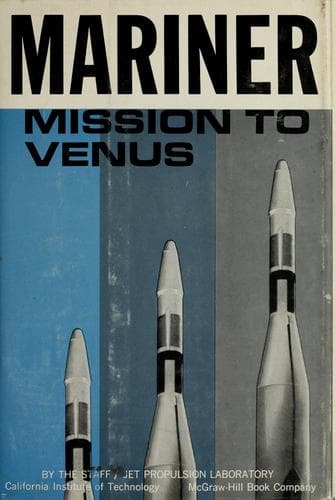
Mariner Mission to VenusJet Propulsion Laboratory (U.S.)
Science
Mariner Mission to Venus
Jet Propulsion Laboratory (U.S.)
Project Mariner (U.S.)
The spacecraft’s temperature control system was made as thermally
self-sufficient as possible. Paint patterns, aluminum sheet, thin gold
plating, and polished aluminum surfaces reflected and absorbed the
proper amount of heat necessary to keep the spacecraft and its
subsystems at the proper operating temperatures.
Thermal shields were used to protect the basic hexagon components. The
upper shield, constructed of aluminized plastic on a fiberglass panel,
protected the top of the basic structure and was designed for maximum
immunity to ultraviolet radiation. The lower shield was installed below
the hexagon; it was made of aluminum plastic faced with aluminum foil
where it was exposed to the blast of the midcourse rocket engine
exhaust.
[Illustration: _Methods used to control the temperature of the
Mariner spacecraft in flight._]
CHROMATE CONVERSION COATING
UPPER THERMAL SHIELD
POLISHED ALUMINUM
LOUVERS
GOLD PLATE
BLACK PAINT
LOWER THERMAL SHIELD
WHITE PAINT
The six electronics cases on the hexagon structure were variously
treated, depending upon the power of the components contained in each.
Those of high power were coated with a good radiating surface of white
paint; assemblies of low power were provided with polished aluminum
shields to minimize the heat loss.
The case housing the attitude control and CC&S electronics circuits was
particularly sensitive because the critical units might fail above 130
degrees F. A special assembly was mounted on the face of this case; it
consisted of eight movable, polished aluminum louvers, each actuated by
a coiled, temperature-sensitive, bimetallic element. When the
temperature rose, the elements acted as springs and opened the louvers.
A drop in temperature would close them.
Structures and bracket assemblies external to the basic hexagon were
gold plated if made of magnesium, or polished if aluminum. Thus
protected, these items became poor thermal radiators as well as poor
solar absorbers, making them relatively immune to solar radiation.
External cabling was wrapped in aluminized plastic to produce a similar
effect.
The solar panels were painted on the shaded side for maximum radiation
control properties. Other items were designed so that the internal
surfaces were as efficient radiators as possible, thus conserving the
spacecraft’s heat balance.
THE SCIENTIFIC INSTRUMENTS
Four instruments were operated throughout the cruise and encounter modes
of Mariner: a magnetometer, a solar plasma detector, a cosmic dust
detector, and a combined charged-particle detector and radiation
counter. Two radiometers were used only in the immediate vicinity of
Venus.
These instruments are described in detail in Chapter 8.
CHAPTER 4
THE LAUNCH VEHICLE
Public-domain text, read in full here on John Shaqi.
Reviews
Reviews
No reviews yet
Be the first to share your thoughts on this work.
Join the Discussion
Join the discussion
Sign in to leave a comment or review.
Sign InorCreate an account