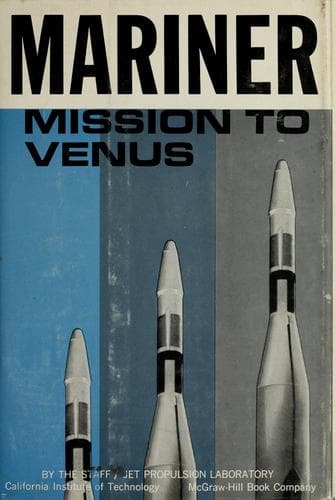
Mariner Mission to VenusJet Propulsion Laboratory (U.S.)
Science
Mariner Mission to Venus
Jet Propulsion Laboratory (U.S.)
Project Mariner (U.S.)
The motive power of Mariner itself was limited to a trajectory
correction rocket engine and an ability, by means of gas jets, to keep
its two critical faces pointing at the Sun and the Earth. Therefore, the
spacecraft had to be boosted out of the Earth’s gravitational field and
injected into a flight path accurate enough to allow the trajectory
correction system to alter the course to deliver the spacecraft close
enough to Venus to be within operating range of the scientific
instruments.
The combined Atlas-Agena B booster system which was selected to do the
job had a total thrust of about 376,000 pounds. With this power,
Atlas-Agena could put 5,000 pounds of payload into a 345-mile orbit,
propel 750 pounds on a lunar trajectory, or launch approximately 400
pounds on a planetary mission. This last capability would be taxed to
the limit by the 447 pounds of the Mariner spacecraft.
THE ATLAS BOOSTER: POWER OF SIX 707’S
The 360,000 pounds of thrust developed by the Atlas D missile is
equivalent to the thrust generated by the engines of six Boeing 707 jet
airplanes. All of this awesome power requires a gargantuan amount of
fuel: in less than 20 seconds, Atlas consumes more than a
propeller-driven, four-engine airplane burns in flying coast-to-coast
nonstop.
[Illustration: _Photo courtesy of General Dynamics/Astronautics_
_This military version of the Atlas missile is modified for NASA
space flights._]
The Atlas missile, as developed by Convair for the Air Force, has a
range of 6,300 miles and reaches a top speed of 16,000 miles per hour.
The missile has been somewhat modified for use by NASA as a space
booster vehicle. Its mission was to lift the second-stage Agena B and
the Mariner spacecraft into the proper position and altitude at the
right speed so that the Agena could go into Earth orbit, preliminary to
the takeoff for interplanetary space.
The Atlas D has two main sections: a body or sustainer section, and a
jettisonable aft, or booster engine section. The vehicle measures about
100 feet in length (with military nose cone) and has a diameter of 10
feet at the base. The weight is approximately 275,000 pounds.
No aerodynamic control surfaces such as fins or rudders are used. The
Atlas is stabilized and controlled by “gimbaling” or swiveling the
engine thrust chambers by means of a hydraulic system. The direction of
thrust can thus be altered to control the movements of the missile.
The aft section mounts two 154,500-pound-thrust booster engines and the
entire section is jettisoned or separated from the sustainer section
after the booster engines burn out. The 60,000-pound-thrust sustainer
engine is attached at the center line of the sustainer section. Two
1,000-pound-thrust vernier (fine steering) engines are installed on
opposite sides of the tank section in the yaw or side-turn plane.
Public-domain text, read in full here on John Shaqi.
Reviews
Reviews
No reviews yet
Be the first to share your thoughts on this work.
Join the Discussion
Join the discussion
Sign in to leave a comment or review.
Sign InorCreate an account