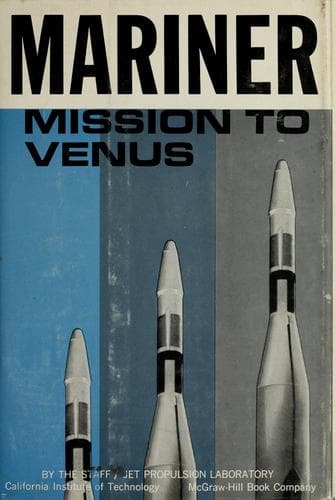
Mariner Mission to VenusJet Propulsion Laboratory (U.S.)
Science
Mariner Mission to Venus
Jet Propulsion Laboratory (U.S.)
Project Mariner (U.S.)
The liquid-burning engine develops more than 16,000 pounds of thrust.
The propellants are a form of hydrazine and red fuming nitric acid.
The Agena can be steered to a desired trajectory by swiveling the
gimbal-mounted engine on command of the guidance system. The attitude of
the vehicle is controlled either by gimbaling the engine or by ejecting
gas from pneumatic thrusters.
The Agena has the ability to restart its engine after it has already
fired once to reach an Earth orbital speed. This feature makes possible
a significant increase in payload and a change of orbital altitude. A
velocity meter ends the first and second burns when predetermined
velocities have been reached.
After engine cutoff, the major reorientation of the vehicle is achieved
through gas jets controlled from an electronic programming device. This
system can turn the Agena completely around in orbit, or pitch it down
for reentry into the atmosphere. The attitude is controlled by an
infrared, heat-sensitive horizon scanner and gyroscopes.
The principal modification to the Agena vehicle for the Mariner II
mission was an alteration to the spacecraft-Agena adapter in order to
reduce weight.
CHAPTER 5
FLIGHT INTO SPACE
With the Mariner R Project officially activated in the fall of 1961 and
the launch vehicles selected, engineers proceeded at full speed to meet
the difficult launch schedule.
A preliminary design was adopted in late September, when the scientific
experiments to be carried on board were also selected. By October 2, a
schedule had been established that would deliver two spacecraft to the
assembly building in Pasadena by January 15 and 29, 1962, respectively,
with the spares to follow in two weeks.
During the week of November 6, tests were underway to determine problems
involved in mating a mock-up of the spacecraft with the Agena shroud and
adapter assembly. A thermal control model of the spacecraft had already
gone into the small space simulator at JPL for preliminary temperature
tests.
MR-1, the first Mariner scheduled for flight, was in assembly
immediately after January 8, 1962, and the process was complete by the
end of the month, when electrical and magnetic field tests had been
started. At the same time, assembly of MR-2 was underway. Work on MR-1
was a week ahead of schedule by the end of the month.
A full-scale temperature control model of the spacecraft went into the
large space simulator on February 26. In mid-March, system tests began
on both spacecraft and it was decided that the flight hardware would be
tested only in the small simulator, with the temperature control model
continuing in the large chamber.
[Illustration: _Technician wears hood and protective goggles while
working on Mariner spacecraft in Space simulator chamber at Jet
Propulsion Laboratory, Pasadena._]
Public-domain text, read in full here on John Shaqi.
Reviews
Reviews
No reviews yet
Be the first to share your thoughts on this work.
Join the Discussion
Join the discussion
Sign in to leave a comment or review.
Sign InorCreate an account