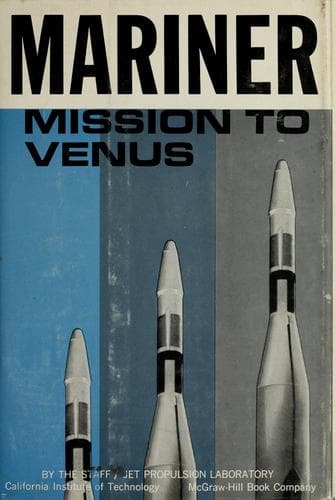
Mariner Mission to VenusJet Propulsion Laboratory (U.S.)
Science
Mariner Mission to Venus
Jet Propulsion Laboratory (U.S.)
Project Mariner (U.S.)
On March 26, MR-1 was subjected to full-scale mating tests with the
shroud (cover) and the adapter for mounting the spacecraft on top of the
Agena. MR-2 was undergoing vibration tests during the week of April 16.
By April 30, MR-1 had completed vibration tests and had been mapped for
magnetic fields so that, once compensated for, they would not interfere
with the magnetometer experiment in space.
A dummy run of MR-1 was conducted on May 7 and the spacecraft, space
flight center, and computing equipment were put through a simulated
operations test run during the same week.
By May 14, clean-up and final inspection by microscope had begun on
MR-1, MR-2, and MR-3 (the latter spacecraft had been assembled from the
spares). Soon after, the first two van loads of equipment were shipped
to Cape Canaveral. The final system test of MR-1 was completed on May 21
and the test of MR-2 followed during the same week.
During the week of May 28, all three spacecraft and their associated
ground support equipment were packed, loaded, and shipped to the
Atlantic Missile Range (AMR). At the same time, the Atlas designated to
launch MR-1 went aboard a C-133 freight aircraft at San Diego. On the
same day, an Air Force order grounded all C-133’s for inspection and the
plane did not depart until June 9.
By June 11, 1962, the firing dates had been established and both
spacecraft were ready for launching. The Atlas booster had already been
erected on the launch pad. The dummy run and a joint flight acceptance
test were completed on MR-1 during the week of July 2. Final flight
preparations and system test of MR-1 and the system test of MR-2 were
concluded a week later.
Thus, in 324 days, a new spacecraft project had been activated; the
design, assembly, and testing had been completed; and the infinite
number of decisions pertaining to launch, AMR Range Operations,
deep-space tracking, and data processing activities had been made and
implemented.
Venus was approaching the Earth at the end of its 19-month excursion
around the Sun. The launch vehicles and Mariners I and II stood ready to
go from Canaveral’s Launch Complex 12. The events leading to the first
close-up look at Venus and intervening space were about to reach their
first crisis: a fiery explosion over the Atlantic Ocean.
MARINER I: AN ABORTIVE LAUNCH
After 570 hours of testing, Mariner I was poised on top of the
Atlas-Agena launch vehicle during the night of July 20, 1962. The time
was right, the Range and the tracking net were standing by, the launch
vehicles were ready to cast off the spacecraft for Venus.
[Illustration: _Atlas for launching Mariner II arrives at Cape
Canaveral in C-133 aircraft._]
The countdown was begun at 11:33 p.m., EST, July 20, after several
delays because of trouble in the Range Safety Command system. At the
time, the launch count stood at T minus 176 minutes—if all went well,
176 minutes until the booster engines were ignited.
Public-domain text, read in full here on John Shaqi.
Reviews
Reviews
No reviews yet
Be the first to share your thoughts on this work.
Join the Discussion
Join the discussion
Sign in to leave a comment or review.
Sign InorCreate an account