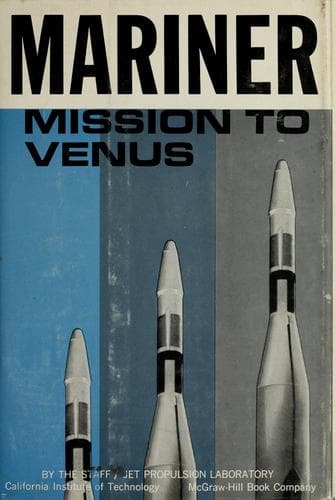
Mariner Mission to VenusJet Propulsion Laboratory (U.S.)
Science
Mariner Mission to Venus
Jet Propulsion Laboratory (U.S.)
Project Mariner (U.S.)
ORIENTATION AND MIDCOURSE MANEUVER
As Mariner II headed into space, the Deep Space Instrumentation Facility
(DSIF) network began to track the spacecraft. At 2:23.59 a.m., DSIF 5 at
Johannesburg, aided by the Mobile Tracking Station, installed in vans in
the vicinity, was “looking” at the spacecraft, just four minutes after
injection.
Johannesburg was able to track Mariner until 4:04 p.m. because, as the
trajectory took Mariner almost radially away from the Earth, our planet
began in effect to turn away from under the spacecraft. On an Earth map,
because of its course and the rotation of the Earth, Mariner II appeared
to describe a great arc over the Indian Ocean far to the west of
Australia, then to turn north and west and to proceed straight west over
south-central Africa, across the Atlantic, and over the Amazon Basin of
northern South America. Johannesburg finally lost track at a point over
the middle of South America.
While swinging over the Indian Ocean on its first pass, the spacecraft
was acquired by Woomera’s DSIF 4 at 2:42.30 a.m., and tracked until 8:08
a.m., when Mariner was passing just to the north of Madagascar on a
westerly course. Goldstone did not acquire the spacecraft until it was
approaching the east coast of South America at 3:12 p.m., August 27.
With Mariner slowly tumbling in free space, it was now necessary to
initiate a series of events to place the spacecraft in the proper flight
position. At 2:27 a.m., 44 minutes after launch, the Mariner Central
Computer and Sequencer (CC&S) on board the spacecraft issued a command
for explosively activated pin pullers to release the solar panels and
the radiometer dish from their launch-secured positions. At 2:53, 60
minutes after liftoff, the attitude control system was turned on and the
Sun orientation sequence began with the extension of the directional
antenna to a preset angle of 72 degrees.
[Illustration: _Mariner II was launched while Venus was far behind
the Earth. During the 109-day flight, Venus overtook and passed the
Earth. It rendezvoused with the spacecraft at a point about
36,000,000 miles from the Earth._]
[Illustration: _During the midcourse maneuver, the trajectory of
Mariner II was corrected so that the spacecraft would approach
within 21,598 miles of Venus._]
ROLL MANEUVER ANTENNA UP
PITCH MANEUVER
MOTOR BURN
SUN REAQUISITION ANTENNA REPOSITION
EARTH REAQUISITION
The Sun sensors then activated the gas jets and moved the spacecraft
about until the roll or long axis was pointed at the Sun. This maneuver
required only 2½ minutes after the CC&S issued the command. The solar
panel power output of 195 watts was somewhat higher than anticipated, as
were the spacecraft temperatures, which decreased and stabilized six
hours after the spacecraft oriented itself on the Sun.
Public-domain text, read in full here on John Shaqi.
Reviews
Reviews
No reviews yet
Be the first to share your thoughts on this work.
Join the Discussion
Join the discussion
Sign in to leave a comment or review.
Sign InorCreate an account