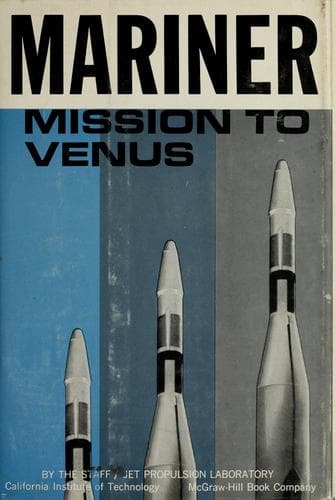
Mariner Mission to VenusJet Propulsion Laboratory (U.S.)
Science
Mariner Mission to Venus
Jet Propulsion Laboratory (U.S.)
Project Mariner (U.S.)
During the launch, Cape radar had tracked the radar beacon on the Agena,
losing it on the horizon at 2:00.53 a.m. Radar stations at Grand Bahama
Island, San Salvador, Ascension, the Twin Falls Victory ship, and
Pretoria (in South Africa) continued to track down range. Meanwhile,
Antigua had “locked on” and tracked the spacecraft’s radio transponder
and telemetry from 1:58 to 2:08 a.m. when it went over the Antigua
horizon.
[Illustration: _Mariner II is accelerated to Earth-escape velocity
and out of orbit near St. Helena. Rotation of earth causes flight
path to appear to double back to west over Africa._]
[Illustration: _The sequence of events in the launch phase of the
Mariner flight to Venus._]
EVENT
1. LIFTOFF
2. ATLAS BOOSTER ENGINE CUTOFF
3. ATLAS SUSTAINER ENGINE CUTOFF
4. ATLAS VERNIER ENGINE CUTOFF
5. SPACECRAFT SHROUD EJECTION
6. ATLAS-AGENA B SEPARATION
7. AGENA B FIRST IGNITION
8. AGENA B FIRST CUTOFF
9. AGENA B SECOND IGNITION
10. AGENA B SECOND CUTOFF
11. SPACECRAFT SEPARATION
12. INITIATE AGENA YAW MANEUVER
13. COMPLETE AGENA YAW MANEUVER
14. EXPEL UNUSED AGENA PROPELLANT
The second coasting period lasted 16.3 minutes, a time determined by the
ground guidance computer and transmitted to the Agena during the vernier
burning period of Atlas. Then, Agena restarted its engine and fired for
a second time. At the end of this firing period, both the Agena and
Mariner, still attached, had been injected into a transfer trajectory to
Venus at a velocity exceeding that required to escape from the Earth’s
gravity.
The actual injection into space occurred at 26 minutes 3.08 seconds
after liftoff from the Cape (2:19.19 a.m., EST) at a point above 14.873
degrees south latitude and 2.007 degrees west longitude. Thus, Mariner
made the break for Venus about 360 miles northeast of St. Helena, 2,500
miles east of the Brazilian coast, and about 900 miles west of Angola on
the west African shore.
During injection, the vehicle was being tracked by Ascension, telemetry
ship Twin Falls Victory, and Pretoria. Telemetry ship Whiskey secured
the spacecraft signal just after injection and tracked until 2:26 a.m.
Pretoria began its telemetry track at 2:21 and continued to track for
almost two hours, until 4:19 a.m.
Injection velocity was 7.07 miles per second or 25,420 miles per hour,
just beyond Earth-escape speed. The distance at the time of injection
from Canaveral’s Launch Complex 12 was 4,081.3 miles.
The Agena and Mariner flew the escape path together for another two
minutes after injection before they were separated at 2:21 a.m. Agena
then performed a 140-degree yaw or retro-turn maneuver by expelling
unused propellants. The purpose was to prevent the unsterilized Agena
from possibly hitting the planet, and from following Mariner too closely
and perhaps disturbing its instruments.
Now, Mariner II was flying alone and clear. Ahead lay a journey of 109
days and more than 180 million miles.
Public-domain text, read in full here on John Shaqi.
Reviews
Reviews
No reviews yet
Be the first to share your thoughts on this work.
Join the Discussion
Join the discussion
Sign in to leave a comment or review.
Sign InorCreate an account