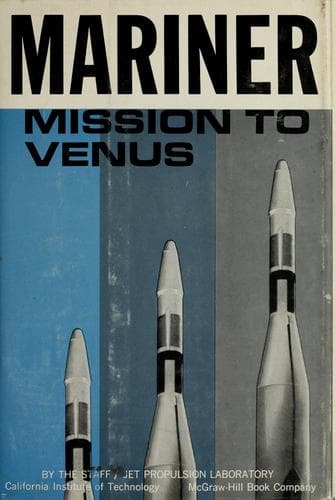
Mariner Mission to VenusJet Propulsion Laboratory (U.S.)
Science
Mariner Mission to Venus
Jet Propulsion Laboratory (U.S.)
Project Mariner (U.S.)
To the world at large, this warbling tone was a signal that the United
States had moved ahead—reached out to the planets. Mariner was exploring
the future, seeking answers to some of the unsolved questions about the
solar system.
THE DOUBLE STAR OF THE ANCIENT WORLD
Venus, the glittering beacon of our solar system, has intrigued man for
at least 4,000 years. The Babylonians first mentioned the brilliant
planet on clay tablets as early as 2,000 years before Christ. The
Egyptians, the Greeks, and the Chinese had thought of Venus as two stars
because it was visible first in the morning and then in the evening sky.
The Greeks had called the morning star Phosphorus and the evening star
Hesperos. By 500 B.C. Pythagoras, the Greek philosopher, had realized
that the two were identical.
Galileo discovered the phases of Venus in 1610. Because of the planet’s
high reflectivity, Copernicus falsely concluded that Venus was either
self-luminous or else transparent to the rays of the Sun.
Venus was tracked across the face of the Sun in 1761, from which event
the presence of an atmosphere about the planet was deduced because of
the fuzzy edges of the image visible in the telescope. Throughout the
eighteenth and nineteenth centuries, Venus continued to excite growing
scientific curiosity in Europe and America.
[Illustration: _Venus’ orbit is almost circular. At inferior
conjunction, the planet is between the Earth and the Sun,
approximately 26,000,000 miles away; at superior conjunction, Venus
is on the other side of the Sun. The elongations are the farthest
points to the east and the west of the Earth._]
Even the development of giant telescopes and the refinement of
spectroscopic and radar astronomy techniques in recent times had yielded
few indisputable facts about Venus. Until radar studies, made from
Goldstone, California, in 1962, neither the rate nor the angle of axial
spin could be determined with any degree of accuracy. The ever-shifting
atmosphere continued to shield the Venusian surface from visual
observation on Earth, and the nature of its atmosphere became an
especially controversial mystery.
THE CONSENSUS PRIOR TO MARINER II
Venus is a virtual twin of the Earth; it approaches our planet closer
than any celestial body except the Moon, a few vagrant comets, and other
such galactic wanderers. Long fabled in song and legend as the most
beautiful object in the sky, Venus has an albedo, or reflectivity
factor, of 59% (the Moon has one of 7%). In its brightest or crescent
phase, Venus glows like a torch, even casting a distinct shadow—the only
body other than the Sun and the Moon yielding such light.
Venus’ diameter is approximately 7,700 miles, compared with Earth’s
7,900. Also as compared with 1.0 for the Earth, Venus’ mean density is
0.91, the mass 0.81, and the volume 0.92.
Public-domain text, read in full here on John Shaqi.
Reviews
Reviews
No reviews yet
Be the first to share your thoughts on this work.
Join the Discussion
Join the discussion
Sign in to leave a comment or review.
Sign InorCreate an account