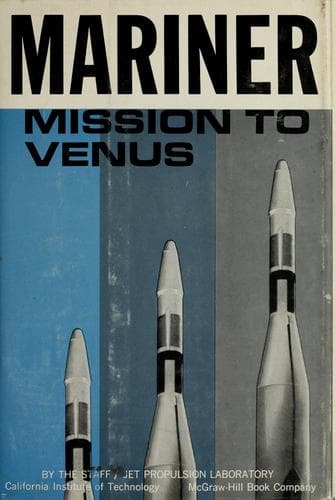
Mariner Mission to VenusJet Propulsion Laboratory (U.S.)
Science
Mariner Mission to Venus
Jet Propulsion Laboratory (U.S.)
Project Mariner (U.S.)
Halfway between Los Angeles and Las Vegas, the California country climbs
southward out of the sunken basin of Death Valley onto the
3500-foot-high floor of the Mojave desert.
On this immense plateau in an area near Goldstone Dry Lake, about 45
miles north of the town of Barstow, a group of 85-foot antennas forms
the nucleus of the United States’ world-wide, deep-space tracking
network.
Here, on the morning of December 14, 1962, several men were gathered in
the control building beneath one of the antennas, listening intently to
the static coming from a loudspeaker. They were surrounded by the exotic
equipment of the space age. Through the window loomed the gleaming metal
framework of an antenna.
Suddenly a voice boomed from the loudspeaker: “The numbers are changing.
We’re getting data!”
The men broke into a cheer, followed by an expectant silence.
Again the voice came from the speaker: “The spacecraft’s crossing the
terminator ... it’s still scanning.”
At that moment, some 36 million miles from the Earth, the National
Aeronautics and Space Administration’s Mariner[1] spacecraft was passing
within 21,600 miles of the planet Venus and was radioing back
information to the Goldstone Station—the first scientific data ever
received by man from the near-vicinity of another planet.
At the same time, in Washington, D.C., a press conference was in
progress. Mr. James E. Webb, Administrator of the National Aeronautics
and Space Administration, and Dr. William H. Pickering, Director of the
Jet Propulsion Laboratory, stood before a bank of microphones. In a few
moments, Dr. Pickering said, the audience would hear the sound of
Mariner II as it transmitted its findings back to the Earth.
Then, a musical warble, the voice of Mariner II, resounded in the hall
and in millions of radios and television sets around the nation.
Alluding to the Greek belief that harmonious sounds accompanied the
movement of the planets, Dr. Pickering remarked that this, in truth, was
the music of the spheres.
Mariner II had been launched from Cape Canaveral, Florida, on August 27,
1962. Its arrival at Venus was the culmination of a 109-day journey
through the strange environment of interplanetary space. The project had
gone from the drawing board to the launching pad in less than 11 months.
Mariner had taxed the resources and the manpower of the Jet Propulsion
Laboratory, California Institute of Technology; the Atlantic Missile
Range centering at Cape Canaveral; theoretical and experimental
laboratories at several universities and NASA centers; numerous elements
of the aerospace industry; and, of course, NASA management itself.
To the considerable body of engineers scattered around the world from
Pasadena to Goldstone to South Africa to Australia, the warble of
Mariner was something more than “the music of the spheres.” Intercept
with Venus was the climax of 109 days of hope and anxiety.
Public-domain text, read in full here on John Shaqi.
Reviews
Reviews
No reviews yet
Be the first to share your thoughts on this work.
Join the Discussion
Join the discussion
Sign in to leave a comment or review.
Sign InorCreate an account