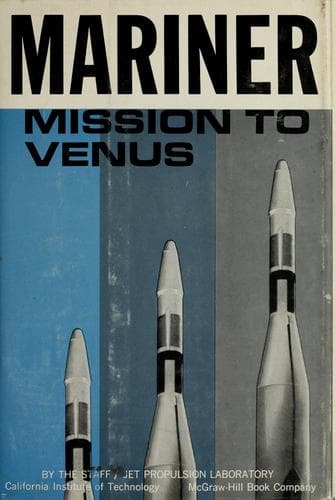
Mariner Mission to VenusJet Propulsion Laboratory (U.S.)
Science
Mariner Mission to Venus
Jet Propulsion Laboratory (U.S.)
Project Mariner (U.S.)
Mariner’s cosmic dust instrument could detect a particle as small as
something like a billionth of a gram, or about five-trillionths of a
pound. This type of sensor had been used on rockets even before Explorer
I. It had yielded good results on Pioneer I in the region between the
Earth and the Moon. The instrument was a 55-square-inch acoustical
detector plate, or sounding board, made of magnesium. A crystal
microphone was attached to the center of the plate. The instrument could
detect both low- and high-momentum particles and also provide a rough
idea of their direction of travel.
The dust particle counters were read once each 37 seconds during the
cruise mode. This rate was increased to once each 20 seconds during the
encounter with Venus.
The instrument was attached to the top of the basic hexagonal structure;
it weighed 1.85 pounds, and consumed only 0.8 watt of power.
SOLAR PLASMA EXPERIMENT
In order to investigate the phenomena associated with the movement of
plasma (charged particles of low energy and density streaming out from
the Sun to form the so-called “solar wind”) in interplanetary space,
Mariner carried a solar plasma spectrometer that measured the flux and
energy spectrum of positively charged plasma components with energies in
the range 240 to 8400 volts. The extremely sensitive plasma detector
unit was open to space, consumed 1 watt of power, and consisted of four
basic elements: curved electrostatic deflection plates and collector
cup, electrometer, a sweep amplifier, and a programmer.
The curved deflector plates formed a tunnel that projected from the
chassis on the spacecraft hexagon in which the instrument was housed.
Pointed toward the Sun, the gold-plated magnesium deflector plates
gathered particles from space. Since the walls of the tunnel each
carried different electrical charges, only particles with just the
correct energy and speed could pass through and be detected by the
collector cup without striking the charged walls. A sensitive
electrometer circuit then measured the current generated by the flow of
the charged particles reaching the cup.
The deflection plates were supplied by amplifier-generated voltages
which were varied in 10 steps, each lasting about 18 seconds, allowing
the instrument to measure protons with energies in the 240 to 8,400
electron volt range. The programmer switched in the proper voltage and
resistances.
HIGH-ENERGY RADIATION EXPERIMENT
Mariner carried an experiment to measure high-energy radiation in space
and near Venus. The charged particles measured by Mariner were primarily
cosmic rays (protons or the nuclei of hydrogen atoms), alpha particles
(nuclei of helium atoms), the nuclei of other heavier atoms, and
electrons. The study of these particles in space and those which might
be trapped near Venus was undertaken in the hope of a better
understanding of the dynamics of the solar system and the potential
hazards to manned flight.
Public-domain text, read in full here on John Shaqi.
Reviews
Reviews
No reviews yet
Be the first to share your thoughts on this work.
Join the Discussion
Join the discussion
Sign in to leave a comment or review.
Sign InorCreate an account