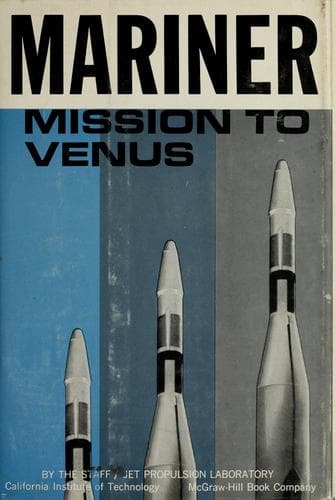
Mariner Mission to VenusJet Propulsion Laboratory (U.S.)
Science
Mariner Mission to Venus
Jet Propulsion Laboratory (U.S.)
Project Mariner (U.S.)
These six scientific experiments represented the cooperative efforts of
scientists at nine institutions: The Army Ordnance Missile Command, the
Ewen-Knight Corp., the California Institute of Technology, the Goddard
Space Flight Center of NASA, Harvard College Observatory, the Jet
Propulsion Laboratory, the Massachusetts Institute of Technology, the
State Universities of Iowa and Nevada, and the University of California
at Berkeley. Table 2 lists the experiments, the experimenters, and their
affiliations.
At the Jet Propulsion Laboratory, the integration of the scientific
experiments and the generation of a number of them were carried out
under the direction of Dr. Manfred Eimer. R. C. Wyckoff was the project
scientist and J. S. Martin was responsible for the engineering of the
scientific experiments.
DATA CONDITIONING SYSTEM
Mariner’s scientific experiments were controlled and their outputs
processed by a data conditioning system which gathered the information
from the instruments and prepared it for transmission to the Earth by
telemetry. In this function, the data system acted as a buffer between
the science systems and the spacecraft data encoder.
The pulse output of certain of the science instruments was counted and
the voltage amplitude representations of other instruments were
converted from analog form to a binary digital equivalent of the
information signals. The data conditioning system also included circuits
to permit time-sharing of the telemetry channels with the spacecraft
engineering data, generation of periodic calibration signals for the
radiometer and magnetometer, and control of the direction and speed of
the radiometer scanning cycle.
During Mariner’s cruise mode, the data conditioning system was used for
processing both engineering and science data. If the spacecraft lost
lock on the Sun or the Earth during the cruise mode, no scientific data
would be telemetered during the reorientation period. Engineering data
were sampled and transmitted for about 17 seconds during every 37-second
interval. The planetary encounter mode involved only science and no
engineering data transmission. In this mode, the science data were
sampled during 20-second intervals.
COSMIC DUST DETECTOR
The cosmic dust detector on Mariner II was designed to measure the flux
density, direction, and momentum of interplanetary dust particles
between the Earth and Venus. These measurements were concerned with the
particles’ direction and distance from the Sun, the momentum with
respect to the spacecraft, the nature of any concentrations of the dust
in streams, variations in cosmic dust flux with distance from the Earth
and Venus, and the possible effects on manned flight.
Public-domain text, read in full here on John Shaqi.
Reviews
Reviews
No reviews yet
Be the first to share your thoughts on this work.
Join the Discussion
Join the discussion
Sign in to leave a comment or review.
Sign InorCreate an account