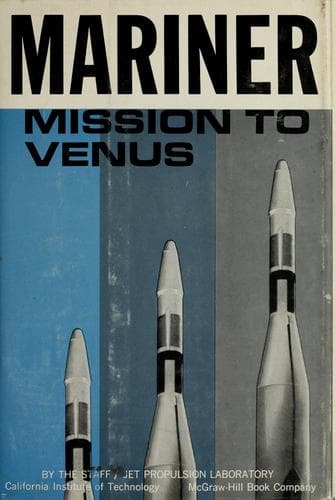
Mariner Mission to VenusJet Propulsion Laboratory (U.S.)
Science
Mariner Mission to Venus
Jet Propulsion Laboratory (U.S.)
Project Mariner (U.S.)
The microwave radiometer was automatically calibrated twenty-three times
during the mission by a sequence originating in the data conditioning
system, so that the correct functioning of the instrument could be
determined before the encounter with Venus.
INFRARED RADIOMETER
The infrared radiometer was a companion experiment to the microwave
instrument and was rigidly mounted to the microwave antenna so that both
radiometers would look at the same area of Venus with the same scanning
rate. The instrument detected radiation in the 8 to 9 and 10 to 10.8
micron regions of the infrared spectrum.
The infrared radiometer had two optical sensors. As the energy entered
the system, it was “chopped” by a rotating disk, alternately passing or
comparing emissions from Venus and from empty space. The beam was then
split by a filter into the two wavelength regions. The output was then
detected, processed, and transmitted to the Earth.
The infrared radiometer measured 6 inches by 2 inches, weighed 2.7
pounds, and consumed 2 watts of power. The instrument was equipped with
a calibration plate which was mounted on a superstructure truss adjacent
to the radiometer.
MARINER’S SCIENTIFIC OBJECTIVES
Equipped with these instruments and with the mechanism for getting the
measurements back to Earth, Mariner II was prepared to look for the
answers to some of the questions inherent in its over-all mission
objectives:
1. The investigation of interplanetary space between the Earth and
Venus, measuring such phenomena as the cosmic dust, the
mysterious plasma or solar winds, high-energy cosmic rays from
space outside our solar system, charged particles from the
Sun, and the magnetic fields of space.
2. The experiments to be performed near Venus (at about 21,150 miles
out from the surface) in an effort to understand its magnetic
fields, radiation belts, the temperature and composition of
its clouds, and the temperature and conditions on the surface
of the planet.
CHAPTER 9
THE LEGACY OF MARINER
If intelligent life had existed on Venus on the afternoon of the Earth’s
December 14, 1962, and if it could have seen through the clouds, it
might have observed Mariner II approach from the night side, drift down
closer, cross over to the daylight face, and move away toward the Sun to
the right. The time was the equivalent of 12:34 p.m. along the Pacific
Coast of the United States, where the spacecraft was being tracked.
Mariner II had reached the climax of its 180-million-mile, 109-day trip
through space. The 35-minute encounter with Venus would tell Earth
scientists more about our sister planet than they had been able to learn
during all the preceding centuries.
SPACE WITHOUT DUST?
Public-domain text, read in full here on John Shaqi.
Reviews
Reviews
No reviews yet
Be the first to share your thoughts on this work.
Join the Discussion
Join the discussion
Sign in to leave a comment or review.
Sign InorCreate an account