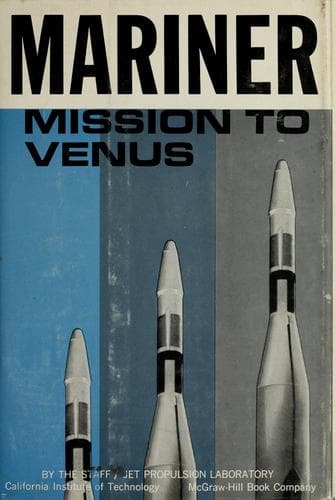
Mariner Mission to VenusJet Propulsion Laboratory (U.S.)
Science
Mariner Mission to Venus
Jet Propulsion Laboratory (U.S.)
Project Mariner (U.S.)
Before Mariner, scientists theorized about the existence of clouds of
cosmic dust around the Sun. A knowledge of the composition, origin, and
the dynamics of these minute particles is necessary for study of the
origins and evolution of the solar system.
Tiny particles of cosmic dust (some with masses as low as 1.3 × 10⁻¹⁰
gram or about one-trillionth of a pound) were thought to be present in
the solar system and have been recorded by satellites in the near-Earth
regions.
These microcosmic particles could be either the residue left over after
our solar system was formed some 5 billion years ago, possibly by
condensation of huge masses of gas and dust clouds; or, the debris
deposited within our system by the far-flung and decaying tails of
passing comets; or, the dust trapped from galactic space by the magnetic
fields of the Sun and the planets.
Analysis of the more than 1,700 hours of cosmic dust detector data
recovered from the flight of Mariner II seems to indicate that in the
region between the Earth and Venus the concentration of tiny cosmic dust
particles is some ten-thousand times less than that observed near the
Earth.
During the 129 days (including the post-encounter period) of Mariner’s
mission, the data showed only one dust particle impact which occurred in
deep space and not near Venus. Equivalent experiments near Earth (on
board Earth satellites) have yielded over 3,700 such impacts within
periods of approximately 500 hours. The cause of this heavy near-Earth
concentration, the exact types of particles, and their source are still
unknown.
The cosmic dust experiment performed well during the Mariner mission.
Although some calibration difficulty was observed about two weeks before
the Venus encounter, possibly caused by overheating of the sensor
crystal, there was no apparent effect in the electronic circuits.
THE UBIQUITOUS SOLAR WIND
For some time prior to Mariner, scientists postulated the existence of a
so-called plasma flow or “solar wind” streaming out from the Sun, to
explain the motion of comet tails (which always point away from the Sun,
perhaps repelled by the plasma), geomagnetic storms, aurorae, and other
such disturbances. (Plasma is defined as a gas in which the atoms are
dissociated into atomic nuclei and electrons, but which, as a whole, is
electrically neutral.)
The solar wind was thought to drastically alter the configuration of the
Sun’s external magnetic field. Plasma moving at extreme velocities is
able to carry with it the lines of magnetic force originating in the
Sun’s corona and to distort any fields it encounters as it moves out
from the Sun.
Public-domain text, read in full here on John Shaqi.
Reviews
Reviews
No reviews yet
Be the first to share your thoughts on this work.
Join the Discussion
Join the discussion
Sign in to leave a comment or review.
Sign InorCreate an account