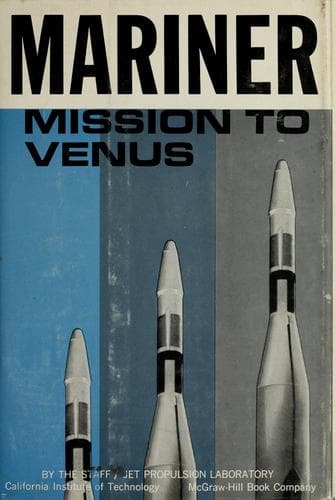
Mariner Mission to VenusJet Propulsion Laboratory (U.S.)
Science
Mariner Mission to Venus
Jet Propulsion Laboratory (U.S.)
Project Mariner (U.S.)
CHAPTER 2
PREPARING FOR SPACE
In the summer of 1961, the United States was pushing hard to strengthen
its position in the exploration of space and the near planets. The
National Aeronautics and Space Administration was planning two projects,
both to be launched by an Atlas booster and a Centaur high-energy second
stage capable of much better performance than that available from
earlier vehicles.
The Mariner program had two goals: Mariner A was ticketed for Venus and
Mariner B was scheduled to go to Mars. Caltech’s Jet Propulsion
Laboratory had management responsibility under NASA for both projects.
These spacecraft were both to be in the 1,000- to 1,250-pound class.
Launch opportunities for the two planets were to be best during the
1962-1964 period and the new second-stage booster known as Centaur was
expected to be ready for these operations.
But trouble was developing for NASA’s planners. By August, 1961, it had
become apparent that the Centaur would not be flying in time to take
advantage of the 1962 third-quarter firing period, when Venus would
approach inferior conjunction with the Earth. JPL studied the problem
and advised NASA that a proposed lightweight, hybrid spacecraft
combining certain design features of Ranger III (a lunar spacecraft) and
Mariner A could be launched to Venus in 1962 aboard a lower-powered
Atlas-Agena B launch vehicle.
[Illustration: _The Mariner II spacecraft was launched by an Atlas
first-stage booster vehicle and an Agena B second stage with restart
capability._]
ATLAS-AGENA ADAPTER
AGENA B
MARINER SPACECRAFT
SHROUD
The proposed spacecraft would be called Mariner R and was to weigh about
460 pounds and carry 25 pounds of scientific instruments (later
increased to 40 pounds). The restart capability of Agena was to be used
in a 98-statute-mile parking orbit. (The orbit was later raised to 115
statute miles and the spacecraft weight was reduced to about 447
pounds.)
Two spacecraft would be launched one after the other from the same pad
within a maximum launch period extending over 56 days from July to
September, 1962. The minimum launch separation between the two
spacecraft would be 21 days.
As a result of the JPL recommendations, NASA cancelled Mariner A in
September, 1961, and assigned JPL to manage a Mariner R Project to fly
two spacecraft (Mariner I and II) to the vicinity of Venus in 1962.
Scientific measurements were to be made in interplanetary space and in
the immediate environs of the planet, which would also be surveyed in an
attempt to determine the characteristics of its atmosphere and surface.
Scientific and engineering data would also be transmitted from the
spacecraft to the Earth while it was in transit and during the encounter
with Venus.
Public-domain text, read in full here on John Shaqi.
Reviews
Reviews
No reviews yet
Be the first to share your thoughts on this work.
Join the Discussion
Join the discussion
Sign in to leave a comment or review.
Sign InorCreate an account