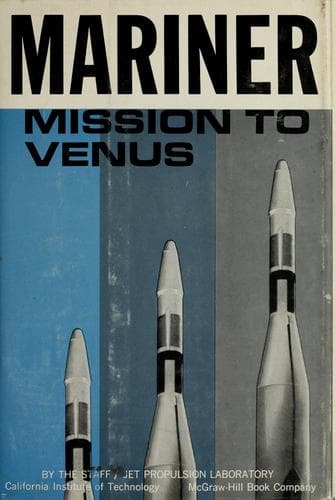
Mariner Mission to VenusJet Propulsion Laboratory (U.S.)
Science
Mariner Mission to Venus
Jet Propulsion Laboratory (U.S.)
Project Mariner (U.S.)
Scientists and engineers were now faced with an arduous task. Within an
11-month period, on a schedule that could tolerate no delays, two
spacecraft had to be designed, developed, assembled, tested, and
launched. In order to meet the schedule, tested flight assemblies and
instruments would have to be in the Pasadena assembly facility by
mid-January, 1962, just four months after the start of the project.
Probably no other major space project of similar scope had ever been
planned on such a demanding schedule.
[Illustration: _Mariner II travelled across 180 million miles of
space within our solar system as it spanned the gap between Earth
and Venus (shown here as the third and second planets, respectively,
from the Sun)._]
With the shipment of equipment to Atlantic Missile Range (AMR) scheduled
for 9½ months after inception of the project, management and design
teams went all-out on a true “crash” effort. Quick decisions had to be
made, a workable design had to be agreed upon very early, and, once
established, the major schedule objectives could not be changed. Certain
design modifications and manufacturing changes in the Atlas-Agena launch
vehicle were also necessary.
Wherever possible, Ranger design technology had to be used in the new
spacecraft and adapted to the requirements of a planetary probe. Other
necessary tasks included trajectory calculation; arrangements for
launch, space flight, and tracking operations; and coordination of AMR
Range support.
Following NASA’s September, 1961 decision to go ahead with the Mariner R
Project, JPL’s Director, Dr. William H. Pickering, called on his
seasoned team of scientists and engineers. Under Robert J. Parks,
Planetary Program Director, Jack N. James was appointed as Project
Manager for Mariner R, assisted by W. A. Collier. Dan Schneiderman was
appointed Spacecraft System Manager, and Dr. Eberhardt Rechtin headed
the space tracking program, with supervision of the Deep Space
Instrumentation Facility (DSIF) operations under Dr. Nicholas Renzetti.
The Mariner space flight operations were directed by Marshall S.
Johnson.
A PROBLEM IN CELESTIAL DYNAMICS
In order to send Mariner close enough to Venus for its instruments to
gather significant data, scientists had to solve aiming and guidance
problems of unprecedented magnitude and complexity.
The 447-pound spacecraft had to be catapulted from a launching platform
moving around the Sun at 66,600 miles per hour, and aimed so precisely
that it would intercept a planet moving 78,300 miles per hour (or 11,700
miles per hour faster than the Earth) at a point in space and time some
180.2 million miles away and 109 days later, with only one chance to
correct the trajectory by a planned midcourse maneuver.
Public-domain text, read in full here on John Shaqi.
Reviews
Reviews
No reviews yet
Be the first to share your thoughts on this work.
Join the Discussion
Join the discussion
Sign in to leave a comment or review.
Sign InorCreate an account