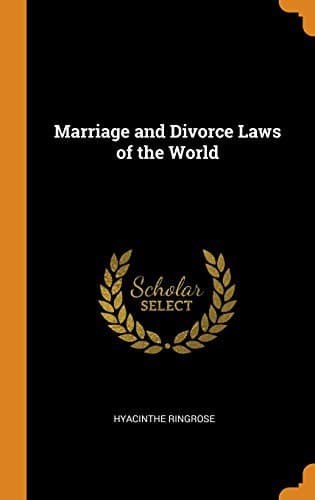
Marriage and Divorce Laws of the WorldRingrose, Hyacinthe
History
Marriage and Divorce Laws of the World
Ringrose, Hyacinthe
Divorce -- Law and legislation; Marriage law
KING'S PROCTOR.--This is the proctor or solicitor representing the Crown
in the Probate, Divorce and Admiralty Division of the High Court of
Justice in matrimonial causes.
In his official capacity he can only intervene in a divorce suit on the
ground of collusion.
Sir James Hannen, discussing the powers of this officer, said in a leading
case: "If, then, the information given to the King's Proctor before the
decree _nisi_ does not rise to a suspicion of collusion, but only brings
to his knowledge matters material to the due decision of the case, he is
not entitled to take any step, and the direction of the Attorney-General
would probably be that he should watch the case to see if these material
facts are brought to the notice of the court. If at the trial they should
be, there will be no need for the King's Proctor to do anything more, for
he would not be entitled to have the same charges tried over again unless
material facts were not brought to the notice of the court.
"If, however, those material facts are not so brought to the notice of the
court by the parties, he will then be entitled as one of the public, but
still acting under the direction of the Attorney-General, to show cause
against the decree being made absolute."
In special cases the court has power to make the decree absolute before
the expiration of six months after the decree _nisi_.
Until the decree is made absolute neither party can lawfully contract
another marriage; and in the event of the suit being contested the parties
must further wait until the time for an appeal has passed.
ALIMONY, TEMPORARY AND PERMANENT.--During the pendency of the suit the
husband is liable to provide his wife with alimony or maintenance. The
amount granted is within the court's discretion, but generally it is about
twenty-five per centum of the husband's income. Upon the granting of a
decree in the wife's favour the court has power to grant the wife
permanent alimony, the amount of which depends on all the facts, such as
the husband's income, the wife's means and the social status of the
parties. If a wife secures an order for alimony against her husband, he
being a man of property, the court may require him to give security for
its payment or direct him to make a transfer of money to a trustee or
trustees for the convenient payment to the wife. Permanent alimony is
usually smaller than temporary alimony, or alimony _pendente lite_, but no
rule as to the amount can be safely stated, it resting in the discretion
of the Court.
If a husband has no considerable property he will be directed to pay the
alimony awarded against him in monthly or weekly instalments.
Public-domain text, read in full here on John Shaqi.
Reviews
Reviews
No reviews yet
Be the first to share your thoughts on this work.
Join the Discussion
Join the discussion
Sign in to leave a comment or review.
Sign InorCreate an account