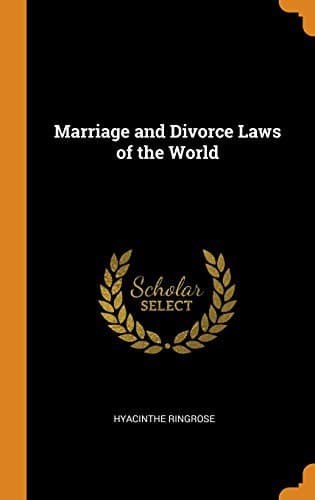
Marriage and Divorce Laws of the World — John Shaqi
Marriage and Divorce Laws of the WorldRingrose, Hyacinthe
History
Marriage and Divorce Laws of the World
Ringrose, Hyacinthe
Divorce -- Law and legislation; Marriage law
INSANITY.--Insanity is neither a cause nor a bar to divorce. If an insane
wife commits adultery, or if an insane husband commits adultery coupled
with the other offences which make out a cause of action against him, the
innocent party is entitled to a decree of divorce. So an insane party may
be a petitioner for divorce, but can only appear by his or her committee
in lunacy.
HUSBAND'S NAME.--A divorced wife is entitled to continue to use her former
husband's surname.
ANNULMENT OF MARRIAGE.--An action for the annulment of marriage has for
its purpose the setting aside of the marriage contract on the theory that
proper consent to the marriage has never been given by both the parties.
The following are the causes or grounds for such annulment:
1. A prior and existing marriage of one of the parties;
2. Impotency, or such physical malformation of one of the parties which
prevents him or her from consummating the marriage by sexual intercourse;
3. Relationship within the prohibited degrees;
4. Marriage procured by fraud, violence or mistake;
5. Insanity of one of the parties at the time of the marriage;
6. Marriage performed without legal license, or without the required
publication of banns.
JUDICIAL SEPARATION.--By the Matrimonial Causes Act a decree of judicial
separation, which is equivalent in effect to a divorce _a mensa et thoro_
under the old law, may be obtained either by the husband or wife on the
ground of adultery, or cruelty, or desertion without legal cause for two
years and upwards.
The defences which may be set up by the respondent vary according to the
cause relied upon by the petitioner, but there is one absolute bar in
suits for judicial separations brought on any ground, and that is that the
petitioner has committed adultery since the date of the marriage.
SEPARATION ORDERS.--Besides the ordinary suit to obtain a judicial
separation which must be prosecuted in the High Court a wife can obtain
speedy and inexpensive relief by making an application to a police
magistrate, or a board of magistrates, for a separation order. This remedy
is limited to married women whose husbands are domiciled in England or
Wales.
Such separation orders are intended to furnish summary relief to the wives
of workingmen, and the amount awarded for the wife's support to be paid by
her husband cannot exceed two pounds a week, no matter what the husband's
income may be.
The following are the causes for which, upon application, a magistrate or
board of magistrates is authorized to grant a separation order:
1. Habitual drunkenness of the husband, which renders him at times
dangerous to himself or others, or incapable of managing himself or his
affairs;
2. When the husband has been convicted of an aggravated assault upon his
wife, or has been convicted by an Assize or Quarter Sessions Court of an
assault and has been sentenced to a fine of more than five pounds or to
imprisonment for more than two months;
Public-domain text, read in full here on John Shaqi.
Reviews
Reviews
No reviews yet
Be the first to share your thoughts on this work.
Join the Discussion
Join the discussion
Sign in to leave a comment or review.
Sign InorCreate an account