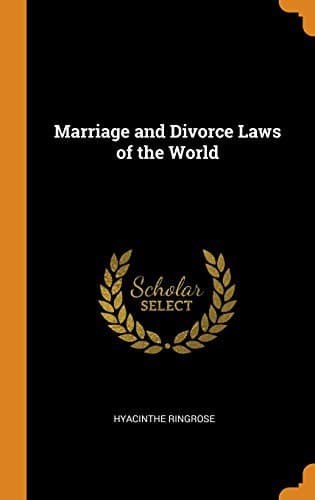
Marriage and Divorce Laws of the WorldRingrose, Hyacinthe
History
Marriage and Divorce Laws of the World
Ringrose, Hyacinthe
Divorce -- Law and legislation; Marriage law
Notice of the proposed marriage must be given fourteen days before the
ceremony, and it must be performed before one of the following officials,
who is termed in the Act a "marriage officer": the British ambassador,
minister or chargé-d'affaires, accredited to the country where the
marriage takes place; the British consul, governor, high commissioner, or
official resident. The term consul in the Act includes a consul-general, a
vice-consul, pro-consul, or consular agent.
If the woman is a British subject, and the man is a subject or citizen of
another country, the marriage officer must be satisfied that the intended
marriage would be recognized by the laws of the country where the man to
be married belongs.
In 1896 there was passed the Marriage with Foreigners Act (6 Edw. 7, 3.
40), which is intended to protect British subjects who contract marriages
with subjects or citizens of other countries, either at home or abroad,
and to run the risk of having their marriages treated as invalid by the
law of the country of the foreign contracting party. It provides for the
granting of certificates by competent authority in the country to which
the foreign party to the marriage owes allegiance, stating that there is
no lawful impediment to the proposed marriage.
CONFLICT OF LAWS.--English courts do not recognize a decree of divorce
granted by the courts of a foreign country as having any effect outside of
the country where granted, unless at the time of the beginning of the
action which resulted in the decree both parties were domiciled within the
jurisdiction of the court which granted it.
This rule applies to divorce decrees obtained in Scotland because for all
the purposes of private international law Scotland is a foreign country.
The English courts will, however, recognize as possessing
extra-territorial validity a decree of divorce which is recognized as
valid by the courts of the country where the parties were actually
domiciled at the time of its being granted.
In the case of Gillig v. Gillig, decided in 1906, the English High Court
recognized as valid in England a divorce granted in South Dakota, U. S.
A., of parties domiciled in New York, because the decree in question was
recognized as valid by the courts of the State of New York. It is the
doctrine of English courts that an honest adherence to the principle that
domicile alone gives jurisdiction in a divorce action will preclude the
scandal which arises when a man and woman are held to be husband and wife
in one country and strangers in another.
CHAPTER III.
SCOTLAND.
Public-domain text, read in full here on John Shaqi.
Reviews
Reviews
No reviews yet
Be the first to share your thoughts on this work.
Join the Discussion
Join the discussion
Sign in to leave a comment or review.
Sign InorCreate an account