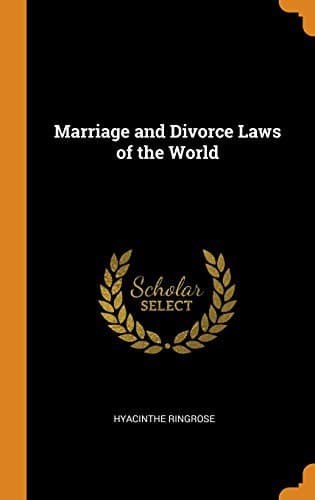
Marriage and Divorce Laws of the WorldRingrose, Hyacinthe
History
Marriage and Divorce Laws of the World
Ringrose, Hyacinthe
Divorce -- Law and legislation; Marriage law
EFFECTS OF DIVORCE.--The judgment of divorce completely sets aside the
marriage, and both parties are free to marry again. On divorce the
innocent party also comes into the immediate enjoyment of all the rights
in the estate of the guilty spouse, or the funds settled by the marriage
contract, as if the offending party had died at the date of the decree.
Conversely, the guilty spouse loses all claim to such legal rights as he
or she would have had on the death of the innocent party but for the
divorce.
CHAPTER IV.
IRELAND.
Ireland like Scotland has its separate judicial system, and many of its
laws differ from those of all other parts of the British Empire.
The Irish law relating to marriage and matrimonial controversies is
administered under the Matrimonial Causes and Marriage Law (Ireland)
Amendment Act of 1870. It is practically the same as the English law as it
existed before 1857.
The Irish Act of 1870 transferred the exercise by the Ecclesiastical
Courts prior to the disestablishment of the Church of Ireland to a court
for matrimonial causes and assigned the trial of such causes to the judge
of the Court of Probate.
Under the Irish Judicature Act of 1877 this jurisdiction is now vested in
the Supreme Court of Judicature and is exercised by the probate and
matrimonial judge.
It is impossible to obtain a decree of divorce from the bonds of matrimony
in the courts of Ireland. The only divorce decree granted is from bed and
board, and amounts in effect to what is termed a judicial separation in
England.
The grounds for the limited form of divorce granted by the courts are
adultery, cruelty or unnatural practices.
In order to obtain a decree of complete divorce the petitioner must
promote a bill in the House of Lords to dissolve the marriage and allow
the petitioner to marry again, which bill must be founded upon and follow
a divorce from bed and board obtained in the Irish courts.
When a petition is presented to the House of Lords a wife must prove her
husband's adultery coupled with cruelty and a husband must prove his
wife's adultery and must, if possible, make his wife's paramour a party by
instituting proceedings against him for criminal conversation in the Irish
courts.
NULLITY.--An action for nullity of marriage can be maintained on the
following grounds: 1. Impuberty. 2. Relationship of the parties within the
prohibited degrees. 3. An existing prior marriage of one of the parties.
4. Incapacity of the parties to conclude the marriage contract, as in the
event of one being a lunatic. 5. Non-compliance with marriage laws. 6.
Fraud in procuring the marriage. 7. Impotency.
CHAPTER V.
THE FRENCH LAW OF MARRIAGE AND DIVORCE.
MARRIAGE.--A man cannot contract a marriage before he has completed his
eighteenth year and a woman until she has completed her fifteenth year.
However, the President of the Republic may grant a dispensation as to age
upon good cause appearing.
Public-domain text, read in full here on John Shaqi.
Reviews
Reviews
No reviews yet
Be the first to share your thoughts on this work.
Join the Discussion
Join the discussion
Sign in to leave a comment or review.
Sign InorCreate an account