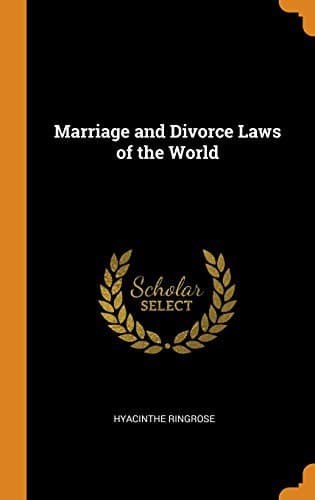
Marriage and Divorce Laws of the WorldRingrose, Hyacinthe
History
Marriage and Divorce Laws of the World
Ringrose, Hyacinthe
Divorce -- Law and legislation; Marriage law
A son who has not reached the age of twenty-five, or a daughter who has
not reached the age of twenty-one, cannot marry without the consent of
their parents; but if the parents disagree between themselves the consent
of the father is sufficient.
If both the father and the mother are dead or unable to give consent the
grandparents take their place.
Sons or daughters less than twenty-one years of age, who have no parents
or grandparents, or only such as are in a condition which renders them
incapable of giving consent, cannot marry without the consent of a family
council.
IMPEDIMENTS.--Marriage is prohibited between all legitimate ascendants and
descendants in the direct line and between persons who are connected by
marriage and related in the same degree. Marriage is also prohibited
between uncle and niece and aunt and nephew. The President of the Republic
may, nevertheless, on good cause being shown, dispense with the
prohibitions contained in the Civil Code forbidding the marriage of a
brother-in-law with a sister-in-law, and the marriage between uncle and
niece, and aunt and nephew.
FORMALITIES.--A marriage must be celebrated publicly before the civil
status officer of the civil domicile of one of the parties. The officer
of the civil status before celebrating a marriage must publish the banns
twice before the door of the Maison Commune, at an interval of eight days.
The President of the Republic, and also the official whom he entrusts with
this power, may dispense, for good cause, with the second publication of
the banns.
FOREIGN MARRIAGES.--A marriage celebrated in a foreign country between
French citizens or between a French citizen and a foreigner is valid if it
is performed according to the forms customary in such country, provided
always that the marriage has been preceded by the publications of the
banns pursuant to the code.
The record of a marriage contracted in a foreign country must be
transcribed within three months of the return of the French citizen to the
territory of the Republic in the public marriage registers of his civil
domicile.
VOIDABLE MARRIAGES.--The validity of a marriage which has been contracted
without the free consent of both parties, or without the free consent of
one of them, can only be impugned by the parties themselves or by the
party whose consent was not freely given.
When there has been an honest mistake as to the personality of one of the
parties the validity of the marriage can only be impugned by the person
who was misled.
Such mistakes as to personality include mistakes as to quality as well as
to identity. For example, the Court of Cassation held in 1861 that where a
woman had been misled into marrying an ex-convict by ignorance of the
fact, the marriage was annulable.
Public-domain text, read in full here on John Shaqi.
Reviews
Reviews
No reviews yet
Be the first to share your thoughts on this work.
Join the Discussion
Join the discussion
Sign in to leave a comment or review.
Sign InorCreate an account