Mary and I: Forty Years with the Sioux — John Shaqi
Mary and I: Forty Years with the SiouxRiggs, Stephen Return
History
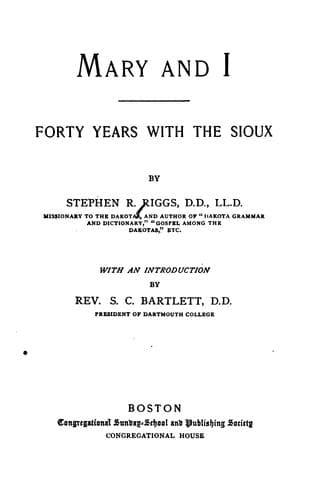
Mary and I: Forty Years with the Sioux
Riggs, Stephen Return
Dakota Indians -- Missions; Riggs, Stephen Return, 1812-1883
But really not much was known of the Sioux until the summer of 1680,
when Hennepin and Du Luth met in a camp of Dakotas, as they hunted
buffalo in what is now north-western Wisconsin. Hennepin had been
captured by a war-party, which descended the Father of Waters in
their canoes, seeking for scalps among their enemies, the Miamis and
Illinois. They took him and his companions of the voyage up to their
villages on the head-waters of Rum River, and around the shores of
Mille Lac and Knife Lake. From the former of these the eastern band of
the Sioux nation named themselves Mdaywakantonwan, _Spirit Lake
Villagers_; and from the latter they inherited the name of Santees
(Isanyati), _Dwellers on Knife_.
These two representative Frenchmen, thus brought together, at so early
a day, in the wilds of the West, visited the home of the Sioux, as
above indicated, and to them we are indebted for much of what we know
of the Dakotas two centuries ago.
The Ojibwas and Hurons were then occupying the southern shores of Lake
Superior, and, coming first into communication with the white race,
they were first supplied with fire-arms, which gave them such an
advantage over the more warlike Sioux that, in the next hundred years,
we find the Ojibwas in possession of all the country on the
head-waters of the Mississippi, while the Dakotas had migrated
southward and westward.
The general enlistment of the Sioux, and indeed of all these tribes of
the North-west, on the side of the British in the war of 1812, showed
the necessity of a strong military garrison in the heart of the Indian
country. Hence the building of Fort Snelling nearly sixty years ago.
At the confluence of the Minnesota with the Mississippi, and on the
high point between the two it has an admirable outlook. So it seemed
to us as we approached it on that first day of June, 1837. On our
landing we became the guests of Lieutenant Ogden and his excellent
wife, who was the daughter of Major Loomis. To Mary and me, every
thing was new and strange. We knew nothing of military life. But our
sojourn of a few days was made pleasant and profitable by the
Christian sympathy which met us there--the evidence of the Spirit's
presence, which, two years before, had culminated in the organization
of a Christian church in the garrison, on the arrival of the first
missionaries to the Dakotas.
Public-domain text, read in full here on John Shaqi.
Reviews
Reviews
No reviews yet
Be the first to share your thoughts on this work.
Join the Discussion
Join the discussion
Sign in to leave a comment or review.
Sign InorCreate an account