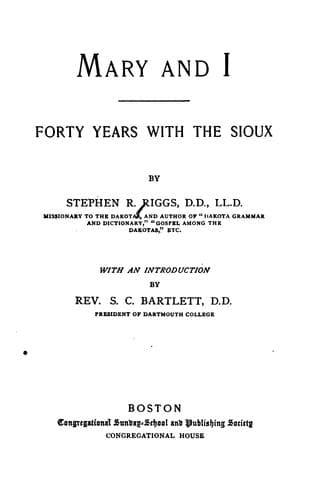
Mary and I: Forty Years with the SiouxRiggs, Stephen Return
History
Mary and I: Forty Years with the Sioux
Riggs, Stephen Return
Dakota Indians -- Missions; Riggs, Stephen Return, 1812-1883
The Falls of St. Anthony and the beautiful Minnehaha have now become
historic, and Minnetonka has become a place of summer resort. But
forty years ago it was only now and then that the eyes of a white man,
and still more rarely the eyes of a white woman, looked upon the Falls
of Curling Water;[2] and scarcely any one knew that the water in
Little Falls Creek came from Minnetonka Lake. But nearer by were the
beautiful lakes Calhoun and Harriet. On the first of these was the
Dakota Village, of which _Claudman_ and _Drifter_ were then the
chiefs; and on whose banks the brothers Pond had erected the first
white man's cabin; and on the north bank of the latter was a mission
station of the American Board, commenced two years before by Rev.
Jedediah D. Stevens.
[2] Minnehaha means "Curling Water," not "Laughing Water," as
many suppose.
Here we were in daily contact with the Dakota men, women, and
children. Here we began to listen to the strange sounds of the Dakota
tongue; and here we made our first laughable efforts in speaking the
language.
We were fortunate in meeting here Rev. Samuel W. Pond, the older of
the brothers, who had come out from Connecticut three years previous,
and, in advance of all others, had erected their missionary cabin on
the margin of Lake Calhoun. Mr. Pond's knowledge of Dakota was quite
a help to us, who were just commencing to learn it. Before we left the
States, it had been impressed upon us by Secretary David Greene that
whether we were successful missionaries or not depended much on our
acquiring a free use of the language. And the teaching of my own
experience and observation is that if one fails to make a pretty good
start the first year in its acquisition, it will be a rare thing if he
ever masters the language. And so, obedient to our instructions, we
made it our first work to get our ears opened to the strange sounds,
and our tongues made cunning for their utterance. Oftentimes we
laughed at our own blunders, as when I told Mary, one day, that _pish_
was the Dakota for _fish_. A Dakota boy had been trying to speak the
English word. Mr. Stevens had gathered, from various sources, a
vocabulary of five or six hundred words. This formed the commencement
of the growth of the Dakota Grammar and Dictionary which I published
fifteen years afterward.
Public-domain text, read in full here on John Shaqi.
Reviews
Reviews
No reviews yet
Be the first to share your thoughts on this work.
Join the Discussion
Join the discussion
Sign in to leave a comment or review.
Sign InorCreate an account