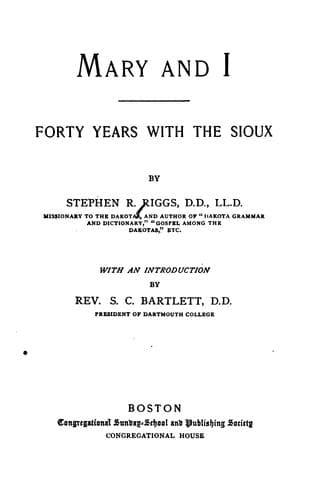
Mary and I: Forty Years with the Sioux — John Shaqi
Mary and I: Forty Years with the SiouxRiggs, Stephen Return
History
Mary and I: Forty Years with the Sioux
Riggs, Stephen Return
Dakota Indians -- Missions; Riggs, Stephen Return, 1812-1883
Mr. and Mrs. Stevens were from Central New York, and were engaged as
early as 1827 in missionary labors on the Island of Mackinaw. In 1829,
Mr. Stevens and Rev. Mr. Coe made a tour of exploration through the
wilds of Northern Wisconsin, coming as far as Fort Snelling. For
several years thereafter, Mr. Stevens was connected with the
Stockbridge mission on Fox Lake; and in the summer of 1835 he had
commenced this station at Lake Harriet. At the time of our arrival he
had made things look quite civilized. He had built two houses of
tamarack logs, the larger of which his own family occupied; the lower
part of the other was used for the school and religious meetings. Half
a dozen boarding scholars, chiefly half-breed girls, formed the
nucleus of the school, which was taught by his niece, Miss Lucy C.
Stevens, who was afterward married to Rev. Daniel Gavan, of the Swiss
mission to the Dakotas.
As the mission family was already quite large enough for comfort, Mary
and I, not wishing to add to any one's burdens, undertook to make
ourselves comfortable in a part of the school-building. Our stay there
was to be only temporary, and hence it was only needful that we take
care of ourselves, and give such occasional help in the way of English
preaching and otherwise as we could. The Dakotas did not yet care to
hear the gospel. The Messrs. Pond had succeeded in teaching one young
man to read and write, and occasionally a few could be induced to come
and listen to the good news. It was seed-sowing time. Many seeds fell
by the wayside or on the hard path of sin. Most fell among thorns. But
some found good ground, and, lying dormant a full quarter of a
century, then sprang up and fruited in the prison at Mankato. Also of
the girls in that first Dakota boarding-school quite a good proportion
became Christian women and the mothers of Christian families.
But the mission at Lake Harriet was not to continue long. In less than
two years from the time we were there, two Ojibwa young men avenged
the killing of their father by waylaying and killing a prominent man
of the Lake Calhoun Village. A thousand Ojibwas had just left Fort
Snelling to return to their homes by way of Lake St. Croix and the Rum
River. Both parties were followed by the Sioux, and terrible slaughter
ensued. But the result of their splendid victory was that the Lake
Calhoun people were afraid to live there any longer, and so they
abandoned their village and plantings and settled on the banks of the
Minnesota.
During our three months' stay at Lake Harriet, every thing we saw and
heard was fresh and interesting, and Mary could not help telling of
them to her friends in Hawley. The grandfather was ninety years old,
to whom she thus wrote:--
"LAKE HARRIET, June 22, 1837.
Public-domain text, read in full here on John Shaqi.
Reviews
Reviews
No reviews yet
Be the first to share your thoughts on this work.
Join the Discussion
Join the discussion
Sign in to leave a comment or review.
Sign InorCreate an account