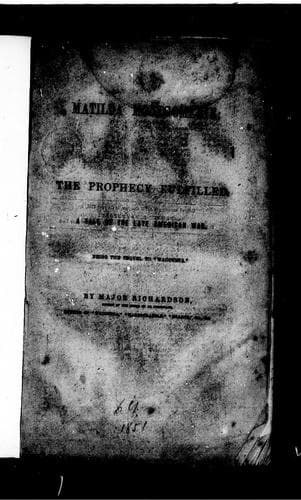
Matilda Montgomerie; Or, The Prophecy FulfilledRichardson, Major (John)
History
Matilda Montgomerie; Or, The Prophecy Fulfilled
Richardson, Major (John)
United States -- History -- War of 1812 -- Fiction
Behind this her pursuer also
disappeared, and after a lapse of a few minutes, pistol and musket shots
were distinguished, although they came but faintly on the ear. These
gradually became more frequent and less distinct, until suddenly there
was a profound pause--then three cheers were faintly heard--and all
again was still.
CHAPTER III.
A full half hour had succeeded to these sounds of conflict, and yet
nothing could be seen of the contending boats. Doubt and anxiety now
took the place of the confidence that had hitherto animated the bosoms
of the spectators, and even Henry Grantham--his heart throbbing
painfully with emotions induced by suspense--knew not what inference to
draw from the fact of his brother's protracted absence. Could it be that
the American, defended as she was by a small force of armed men, had
succeeded, not only in defeating the aim of her pursuer, but also in
capturing her. Such a result was not impossible. The enemy against whom
they had to contend yielded to none in bravery; and as the small bark
which had quitted the gun-boat was not one third of the size of that
which they pursued, it followed of necessity, that the assailants must
be infinitely weaker in numbers than the assailed. Still no signal of
alarm was made by the gun-boat, which continued to lie to, apparently in
expectation of the return of the detached portion of her crew. Grantham
knew enough of his brother's character to feel satisfied that he was in
the absent boat, and yet it was impossible to suppose that one so imbued
with the spirit of generous enterprise should have succumbed to his
enemy, after a contest of so short duration, as, from the number of
shots heard, this had appeared to be. That it was terminated, there
could be no doubt. The cheers, which had been followed by an universal
silence, had given evidence of this fact; yet why, in that case, if his
brother had been victorious, was he not already on his return?
Appearances, on the other hand, seemed to induce an impression of his
defeat. The obvious course of the enemy, if successful, was to abandon
their craft, cut off from escape by the gun-boat without, and to make
the best of their way through the woods, to their place of destination,
the American fort of Detroit--and, as neither party was visible, it was
to be feared this object had been accomplished.
Public-domain text, read in full here on John Shaqi.
Reviews
Reviews
No reviews yet
Be the first to share your thoughts on this work.
Join the Discussion
Join the discussion
Sign in to leave a comment or review.
Sign InorCreate an account