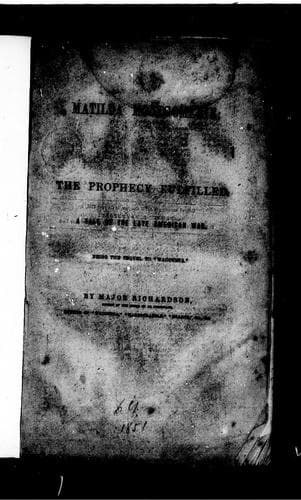
Matilda Montgomerie; Or, The Prophecy FulfilledRichardson, Major (John)
History
Matilda Montgomerie; Or, The Prophecy Fulfilled
Richardson, Major (John)
United States -- History -- War of 1812 -- Fiction
The minds of all were more or less influenced by these doubts, but that
of Henry Grantham was especially disturbed. From the first appearance of
the gun-boat his spirits had resumed their usual tone, for he had looked
upon the fleeing bark as the certain prize of his brother, whose
conquest was to afford the flattest denial to the insinuation that had
been urged against him. Moreover, his youthful pride had exulted in the
reflection that the first halo of victory would play around the brow of
one for whom he could have made every personal sacrifice; and now, to
have those fair anticipations clouded at the very moment when he was
expecting their fullest accomplishment, was almost unendurable. He felt,
also, that, although his resolution was thus made to stand prominently
forth, the prudence of his brother would assuredly be called in
question, for having given chase with so inferior a force, when a single
gun fired into his enemy must have sunk her. In the impatience of his
feelings, the excited young soldier could not refrain from adding his
own censure of the imprudence, exclaiming, as he played his foot
nervously upon the ground: "Why the devil did he not fire and sink her,
instead of following in that nutshell?"
While he was yet giving utterance to his disappointment, a hasty
exclamation met his ear from the chieftain at his side, who, placing one
hand on the shoulder of the officer, with a familiar and meaning grasp,
pointed, with the fore-finger of the other, in the direction in which
the boats had disappeared. Before Grantham's eye could follow, an
exulting yell from the distant masses of Indians announced an advantage
that was soon made obvious to all. The small dark boat of the pursuing
party was now seen issuing from behind the point, and pulling slowly
towards the gun-boat. In the course of a minute or two afterwards
appeared the American, evidently following in the wake of the former,
and attached by a tow-line to her stern. The yell pealed forth by the
Indians when the second boat came in view, was deafening in the extreme;
and everything became commotion along the bank, while the little fleet
of canoes, which still lay resting on the beach, put off one after the
other to the scene of action.
Meanwhile, both objects had gained the side of the gun-boat, which,
favored by a partial shifting of the wind, now pursued her course down
the river with expanded sails. Attached to her stern, and following at
quarter cable distance, was to be seen her prize, from which the
prisoners had been removed.
Informed of the success which had crowned the enterprise of their
officer, the crews of the several vessels in the harbor swelled the
crowd assembled on the bank near the fort, to which point curiosity and
a feeling of interest had moreover brought many of the town's people, so
that the scene finally became one of great animation.
Public-domain text, read in full here on John Shaqi.
Reviews
Reviews
No reviews yet
Be the first to share your thoughts on this work.
Join the Discussion
Join the discussion
Sign in to leave a comment or review.
Sign InorCreate an account