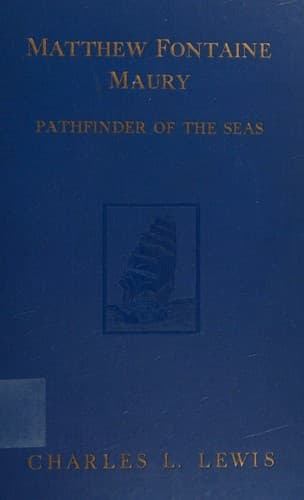
Matthew Fontaine Maury, the Pathfinder of the SeasLewis, Charles Lee
History
Matthew Fontaine Maury, the Pathfinder of the Seas
Lewis, Charles Lee
Maury, Matthew Fontaine, 1806-1873
At the top of all the pilot charts issued by the Hydrographic Office
of the Navy Department are written these words: “Founded upon the
researches made and the data collected by Lieutenant M. F. Maury, U.
S. Navy”. This is an appropriate memorial to Maury’s most practical
contribution to science,—that which has given him the name “Pathfinder
of the Seas”.
For a long time he had recognized the need for charts showing the winds
and currents of the sea at different seasons; and it will be remembered
that, when he was sailing master of the _Falmouth_, 1831–1833, he was
first made to realize how little of the nautical experience of other
sailors could be taken advantage of by one about to set out on a long
voyage. On the way down to Rio in this ship he first conceived the
idea of a wind and current chart; but he had no opportunity to make
practical investigations into the meteorology of the sea until the
year 1842, when he was placed in charge of the Depot of Charts and
Instruments.
He had been in this office but a short time when he set about examining
the old log books which had been stored away as so much rubbish by the
Navy Department. By the middle of the year 1843, these investigations
had proved so illuminating that he was able to write a paper, which was
read before the National Institute, on “Blank Charts on Board Public
Cruisers”. According to his plan, these charts were to have parallels
and meridians showing the latitude and longitude laid down upon them,
and the commanders of ships were to be requested to lay off on them the
tracks of their vessels every day, and indicate as well the time of the
year, the direction of the winds, the force and set of the currents,
and all other phenomena having a bearing on the navigation of the
seas on which they sailed. Sailing directions, Maury declared in this
address, are now not a written branch of navigation but merely a matter
of tradition among seamen. As to his contemplated chart, he boldly
asserted that short passages are not due to luck and that “this chart
proposes nothing less than to _blaze a way_ through the winds of the
sea by which the navigator may find the best paths at all seasons”.
Public-domain text, read in full here on John Shaqi.
Reviews
Reviews
No reviews yet
Be the first to share your thoughts on this work.
Join the Discussion
Join the discussion
Sign in to leave a comment or review.
Sign InorCreate an account