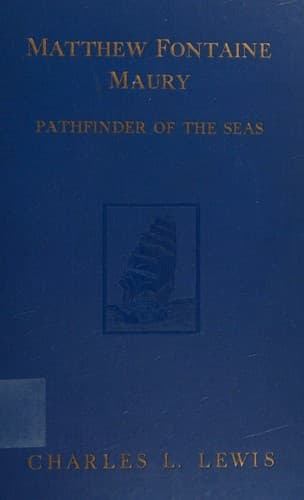
Matthew Fontaine Maury, the Pathfinder of the SeasLewis, Charles Lee
History
Matthew Fontaine Maury, the Pathfinder of the Seas
Lewis, Charles Lee
Maury, Matthew Fontaine, 1806-1873
Under the circumstances it was but natural that there should be races
among the clipper ships. The route from New York to San Francisco
became the great racecourse of the ocean, fifteen thousand miles in
length. As Maury wrote, “Some of the most glorious trials of speed
and prowess that the world ever witnessed, among ships that ‘walk the
waters’, have taken place over it. Here the modern clipper ship—the
noblest work that has ever come from the hands of man—has been sent,
guided by the lights of science, to contend with the elements, to
outstrip steam, and astonish the world”.[5] There was the great race in
1851 of the _Raven_, the _Typhoon_, and the _Sea Witch_, which was won
by the first-mentioned in 105 days, though the year before this same
ship had made the run in 97 days.
Another famous race was run during the winter of 1852–1853, and the
ships which engaged in it were the _Wild Pigeon_, _John Gilpin_,
_Flying Fish_, and _Trade Wind_. These ships, as were those in the
former race, were all furnished with Maury’s charts. After a most
interesting and exciting race, the _Flying Fish_ won in just 92 days
and 4 hours, though the _John Gilpin_ was a close second, making the
passage in 93 days and 20 hours. In commenting on these results,
Maury wrote, “Here are ships sailing on different days, bound over a
trackless waste of ocean for some fifteen thousand miles or more, and
depending alone on the fickle winds of heaven, as they are called, to
waft them along; yet, like travelers on the land bound upon the same
journey, they pass and repass, fall in with and recognize each other by
the way; and what, perhaps, is still more remarkable is the fact that
these ships should each, throughout that great distance and under the
wonderful vicissitudes of climates, winds, and currents, which they
encountered, have been so skillfully navigated that, in looking back at
their management, now that what is past is before me, I do not find a
single occasion, except the one already mentioned, on which they could
have been better handled.... Am I far wrong, therefore, when I say
that the present state of our knowledge, with regard to the physical
geography of the sea, has enabled the navigator to blaze his way among
the winds and currents of the sea, and so mark his path that others,
using his signs as finger-boards, may follow in the same track?”[6]
Public-domain text, read in full here on John Shaqi.
Reviews
Reviews
No reviews yet
Be the first to share your thoughts on this work.
Join the Discussion
Join the discussion
Sign in to leave a comment or review.
Sign InorCreate an account