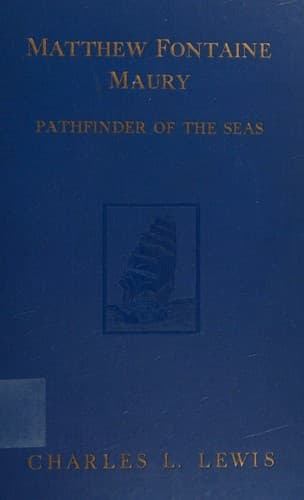
Matthew Fontaine Maury, the Pathfinder of the Seas — John Shaqi
Matthew Fontaine Maury, the Pathfinder of the SeasLewis, Charles Lee
History
Matthew Fontaine Maury, the Pathfinder of the Seas
Lewis, Charles Lee
Maury, Matthew Fontaine, 1806-1873
The degree of exactness which Maury’s knowledge of the sea had reached
is best illustrated by the incident of the _San Francisco_. This ship,
bound from New York to San Francisco with a regiment of soldiers
on board, was disabled in a hurricane on the day before Christmas,
1853 while crossing the Gulf Stream about 300 miles from Sandy Hook.
Her position on the following day, and the next day after that, was
reported by passing vessels which were, however, unable to render
her assistance. Maury was then asked by the Secretary of the Navy to
calculate her position for the assistance of the two relief ships which
were to be dispatched in search of the unfortunate vessel. Although
three other ships, the _Kilby_, the _Three Bells_, and the _Antarctic_,
fell in with the wreck and rescued the remainder of her passengers,
after 179 men had been washed overboard, yet it is an astonishing fact
that Maury had so accurately guided the two searching revenue cutters
that one of them went within sight of the spot where the drifting
vessel had shortly before been found.
There was still another important passage that Maury aided materially
in shortening. This was the voyage from England to Australia and New
Zealand. He opposed the British Admiralty route which passed near
the Cape of Good Hope, and advised ships to sail 600 to 800 miles
further westward and then to continue southward until they reached the
prevailing strong westerly winds which drove the clippers onward at a
tremendous rate. He advised them, when homeward bound, to continue in
those “brave west winds” and return by way of Cape Horn. A voyage out
to Australia and home again, accordingly, encircled the globe. Whereas
by the old route it had taken about 120 days each way on the average,
by Maury’s new route the passage for American sailings was decreased
by one third and that for the British by about one fifth.
This shortening of ships’ passages amounted to a vast saving to
the commerce of the world. It was estimated that the annual saving
to British commerce in the Indian Ocean alone, from Maury’s charts
and sailing directions, amounted to $1,000,000 at least, and the
amount saved to British commerce in all seas reached the stupendous
sum of $10,000,000 annually. As to the United States, it has been
conservatively estimated that the saving for the outward voyage alone
from her Atlantic and California ports to those of South America,
Australia, China, and the East Indies amounted to $2,250,000 per annum.
Public-domain text, read in full here on John Shaqi.
Reviews
Reviews
No reviews yet
Be the first to share your thoughts on this work.
Join the Discussion
Join the discussion
Sign in to leave a comment or review.
Sign InorCreate an account