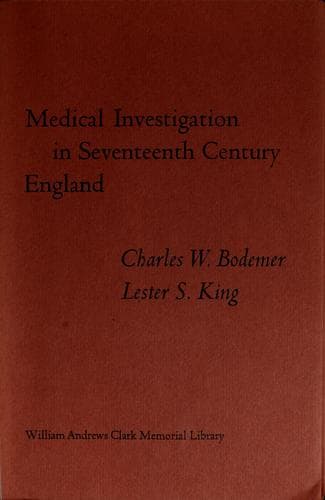
Medical investigation in seventeenth century EnglandBodemer, Charles W.
History
Medical investigation in seventeenth century England
Bodemer, Charles W.
Boyle, Robert, 1627-1691; Embryology -- England -- History -- 17th century
Harvey's treatise on generation is clearly a product of his time. It
advances embryology by its demonstration of certain facts of
development, by its aggressive espousal of epigenesis and the origin of
all animals from eggs, and by its dynamic approach stressing the
temporal factors in development and the initial independent function of
embryonic organs. However, the strong Aristotelian cast of Harvey's
treatise encouraged continued discussion of long outdated questions in
an outdated manner and, combined with his expressed disdain for
"chymistry" and atomism, discouraged close cooperation between
embryologists of different persuasions. It is perhaps easy to
underestimate the impact and general importance of Harvey's work in view
of these qualifications, and so it should be remarked that both positive
and negative features of _De Generatione_ influenced profoundly
subsequent embryological thought.
It will be recalled that the title of _The Philosophicall Touch-Stone_
identified Digby as the object of Alexander Ross's ire. In comparable
manner, the latter's _Arcana Microcosmi_, published in 1652, declares
its purpose to be "a refutation of Dr. Brown's Vulgar Errors, the Lord
Bacon's Natural History, and Dr. Harvy's book _De Generatione_." Let us
pause a brief moment in memory of a man so intrepid as to undertake the
refutation of three of England's great intellects in one small volume,
and then proceed to examine the embryological concepts of one of the
trio, Sir Thomas Browne.
Browne's _Religio Medici_, composed as a private confession of faith
around 1635, is known to all students of English literature, as is his
later, splendid work on death and immortality, _Hydrotaphia,
Urne-Buriall_. One of the greatest stylists of English prose, Browne was
also a physician and a student of generation who deserves our attention
as an early chemical embryologist pointing the way to a form of
embryological investigation prominent in the last half of the
seventeenth century.
Browne's embryological opinions are found particularly in _Pseudodoxia
Epidemica_, _The Garden of Cyrus_, and in his unpublished _Miscellaneous
Writings_. Browne, a well-read man, was educated at Oxford, Montpellier,
Padua, and Leyden, and he was thoroughly imbued with the teaching of the
prophets of the "new learning." This is evident throughout his writings,
as witness his admonition to the reader of the _Christian Morals_:
Let thy Studies be free as thy Thoughts and Contemplations, but fly
not only upon the wings of Imagination; Joyn Sense unto Reason, and
Experiment unto Speculation, and so give life unto Embryon Truths,
and Verities yet in their Chaos.[26]
Public-domain text, read in full here on John Shaqi.
Reviews
Reviews
No reviews yet
Be the first to share your thoughts on this work.
Join the Discussion
Join the discussion
Sign in to leave a comment or review.
Sign InorCreate an account