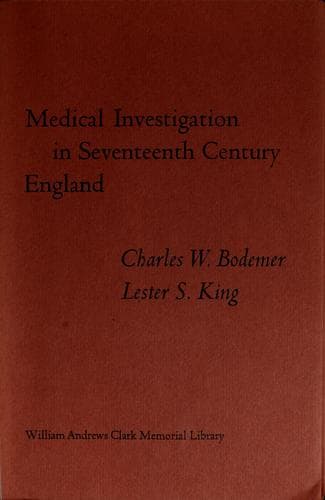
Medical investigation in seventeenth century EnglandBodemer, Charles W.
History
Medical investigation in seventeenth century England
Bodemer, Charles W.
Boyle, Robert, 1627-1691; Embryology -- England -- History -- 17th century
[6] _Ibid._, p. 222.
[7] _Ibid._, p. 215.
[8] _Ibid._, p. 219.
[9] _Ibid._, p. 213.
[10] _Ibid._, pp. 217-219.
[11] _Ibid._, p. 231.
[12] Alexander Ross, _The Philosphicall Touch-Stone; or Observations
upon Sir Kenelm Digbie's Discourses of the nature of Bodies, and of the
reasonable Soule_, London, 1645.
[13] Alexander Ross, _Arcana Microcosmi: or, The hid secrets of Man's
Body disclosed ... In an anatomical duel between Aristotle and Galen
concerning the parts thereof_, London, 1652, p. 87.
[14] Nathaniel Highmore, _The History of Generation, Examining the
several Opinions of divers Authors, expecially that of Sir Kenelm Digby,
in his Discourse of Bodies_, London, 1651, p. 4.
[15] _Ibid._, pp. 26-27.
[16] _Ibid._, pp. 27-28.
[17] _Ibid._, p. 45.
[18] _Ibid._, Pp. 90-91.
[19] William Harvey, _Opera omnia: a Collegio Medicorum Londinensi
edita_, Londini, 1766, p. 136.
[20] William Harvey, _Anatomical Excercises on the Generation of
Animals_, trans. Robert Willis, London, 1847, p. 462.
[21] _Ibid._, pp. 336-339.
[22] _Works of William Harvey_, trans. Robert Willis, London, 1847, pp.
lxx-lxxi.
[23] Harvey, _op. cit._, pp. 462-463.
[24] _Ibid._, p. 457.
[25] F. J. Cole, _Early Theories of Sexual Generation_, Oxford, 1930, p.
140.
[26] Thomas Browne, _The Works_, ed. Geoffrey Keynes, Chicago, 1964, I,
261-262.
[27] _Ibid._, II, 265.
[28] _Ibid._, III, 442.
[29] _Ibid._, III, 442-452.
[30] _Ibid._, I, 50.
[31] _Ibid._, I, 14.
[32] Walter Needham, _Disquisitio anatomica de formato foetu_, London,
1667.
[33] John Mayow, "De Respiratione foetus in utero et ovo," in _Tractatus
Quinque Medico-Physici_, Oxonii, 1674, p. 311.
[34] _Ibid._, pp. 319-320.
[35] Robert Boyle, _The Works_, London, 1772, I, 548-549.
[36] Browne, _op. cit._, II, 261.
II
_Robert Boyle as an Amateur Physician_
LESTER S. KING
Robert Boyle was not a physician. To be sure, he had engaged in some
casual anatomical studies,[37] but he had not formally studied medicine
and did not have a medical degree. Nevertheless, he engaged in what we
would call medical practice as well as medical research and exerted a
strong influence on the course of medicine during the latter seventeenth
century, an influence prolonged well into the eighteenth. He lived
during the period of exciting yet painful transition when medical theory
and practice were undergoing a complete transformation towards what we
may call the "early modern" form. The transition, naturally gradual,
extended over three centuries, but I wish to examine only a very small
fragment of this period, namely, the third quarter of the seventeenth
century.
Public-domain text, read in full here on John Shaqi.
Reviews
Reviews
No reviews yet
Be the first to share your thoughts on this work.
Join the Discussion
Join the discussion
Sign in to leave a comment or review.
Sign InorCreate an account