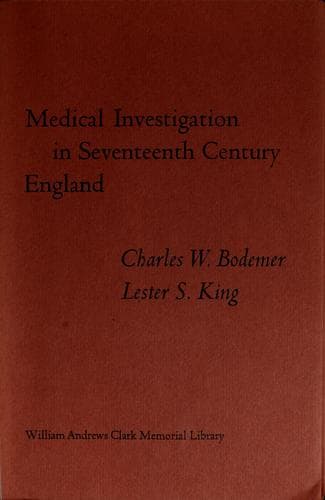
Medical investigation in seventeenth century EnglandBodemer, Charles W.
History
Medical investigation in seventeenth century England
Bodemer, Charles W.
Boyle, Robert, 1627-1691; Embryology -- England -- History -- 17th century
Boyle's first major work which dealt extensively with medical problems
was the _Usefulness of Experimental Philosophy_. This work, although
published in 1663, had been written in two parts, the first much earlier
than the second. Fulton[38] indicates it had been drafted around 1650,
while Hall[39] ascribes it to the period 1647-1648. This first part has
relatively little to do with medicine; the references are few and rather
incidental, and have significance only for the light they throw on
"natural philosophy" and "natural religion." The second part, however,
written apparently not too long before publication, has a great deal to
do with medicine and constitutes one of the important medical documents
of the century.
Deserving of mention is an earlier and minor work of Boyle, indeed, his
first published writing, only recently identified. This work, apparently
written in 1649, bore the title "An Invitation to a free and generous
communication of Secrets and Receits in Physick," and appeared
anonymously in 1655 as part of a volume entitled _Chymical, Medicinal
and Chirurgical Addresses Made to Samuel Hartlib, Esquire_.[40] For our
purposes, it is significant as emphasizing his early interest in
medicine.
Boyle seems to have acquired most of his medical knowledge between, say,
1649 and 1662. It is worth recalling some of the trends and conflicts
that formed the medical environment during this period. Among the major
trends, first place, perhaps, must be given to Galenic doctrine, which
had come under progressively severe attack. Molière, who lived from 1622
to 1673, showed in his comedies the popular reaction to a system which,
although dominant, was clearly crumbling. The cracks in the edifice even
the layman could readily see. Nevertheless, Galenism had its strong
supporters. Riverius, who lived from 1589 to 1655, was a staunch
Galenist. An edition of his basic and clinical works[41] was translated
into English in 1657, and Latin editions continued to be published well
into the eighteenth century.[42]
Galenism, of course, had to withstand the great new discoveries in
anatomy and physiology made by Vesalius, Aselli, Sanctonius, Harvey, and
others, not to mention the host of great investigators who were more
strictly contemporaries of Boyle.
Public-domain text, read in full here on John Shaqi.
Reviews
Reviews
No reviews yet
Be the first to share your thoughts on this work.
Join the Discussion
Join the discussion
Sign in to leave a comment or review.
Sign InorCreate an account