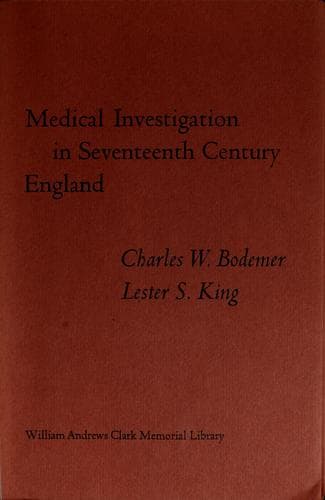
Medical investigation in seventeenth century EnglandBodemer, Charles W.
History
Medical investigation in seventeenth century England
Bodemer, Charles W.
Boyle, Robert, 1627-1691; Embryology -- England -- History -- 17th century
The problem, in a sense, resolves around the notion of credulity. What
shall we believe? Boyle makes some distinctions between what he has seen
with his own eyes and what other people report to have seen. Thus, he
mentions "a very experienced and sober gentleman, who is much talked of"
who cured cancer of the female breast "by the outward application of an
indolent powder, some of which he also gave me." But, he adds
cautiously, he has not yet "had the opportunity to make trial of
it."[52] Clearly, since he cannot make the trial himself, Boyle
withholds judgment, even though the material came from a "very
experienced" gentleman. Or again, he talks about "sober travelers" who
made certain claims regarding the treatment of poisons. But, he says,
"having not yet made any trial of this my self, I dare not build upon
it."[53]
There are numerous such instances, scattered throughout his works, where
he reports an alleged cure but specifically indicates his own mental
reservations. Clearly, he is quite cautious in accepting the statements
of others, even though they were "sober" or "experienced" or even
"judicious." On the other hand, he is extremely uncritical when he
himself uses the term "cure" and when he attributes cures to particular
medicines.
His skepticism he indicates in references, for example, to Paracelsus
and van Helmont. Their specific remedy against "the stone," he says, and
their claims that they can reduce stones to "insipid water, is so
strange (not to say incredible) that their followers must pardon me, if
I be not forward to believe such unlikely things, til sufficient
experience hath convinced me of their truth."[54] Here, of course, we
see further a feature of critical acumen. A claim is made, but if this
claim runs counter to Boyle's own accepted body of knowledge, or to
logical doctrines derived from other directions, mere assertion cannot
carry conviction. "Sufficient experience" must play its part, and just
what constitutes "sufficient" we are not quite sure.
In judging the effectiveness of a remedy or the credibility of a
statement, one of the most important weapons was _analogy_. Direct
observation of a phenomenon was good. Next best was direct observation
of some _analogous_ phenomenon whereby one body acted upon another to
alter its properties or induce significant changes. Boyle drew his
analogies largely from chemistry, but he had no hesitation in applying
them to medicine.
Public-domain text, read in full here on John Shaqi.
Reviews
Reviews
No reviews yet
Be the first to share your thoughts on this work.
Join the Discussion
Join the discussion
Sign in to leave a comment or review.
Sign InorCreate an account