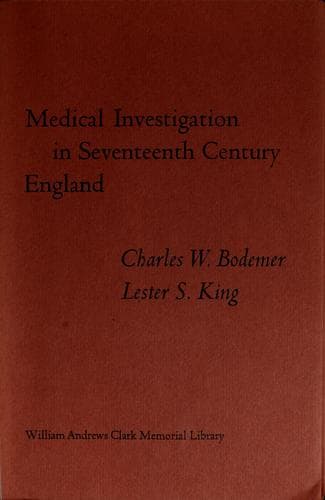
Medical investigation in seventeenth century EnglandBodemer, Charles W.
History
Medical investigation in seventeenth century England
Bodemer, Charles W.
Boyle, Robert, 1627-1691; Embryology -- England -- History -- 17th century
Claims that medicines swallowed by mouth could dissolve stones in the
bladder seemed a priori unlikely. Yet there was considerable authority
that this took place; many persons had reported that this was a _fact_.
Boyle kept an open mind. He might be highly skeptical in regard to the
claims for any particular medication, but he did not deny the principle
involved. The possibility that some fluid, when swallowed, could have a
particular specific action on stones in the bladder, without affecting
the rest of the body, he considered quite plausible through the analogy
that quicksilver has an affinity with gold but has no effect upon iron.
Furthermore, a substance than can corrode a solid body may nevertheless
be unable to "fret" a different body which is considerably softer and
thinner, if the "texture" does not admit the small particles.[55]
Reasoning by analogy served to explain the logical plausibility. In
other words, he was very open-minded. He refused to dismiss all such
claims, and provided analogy as a reason for keeping his mind open; yet
he refused to accept particular claims of medicine that dissolved
stones, because the evidence was not convincing. We could scarcely ask
for more.
An important seventeenth-century medical document was the report of Sir
Kenelm Digby, regarding the so-called "weapon salve." The essay
describing this famous powder was written in 1657, and I have discussed
it at some length elsewhere.[56] Here again Boyle keeps an open mind,
saying, "and if there be any truth in what hath been affirmed to me by
several eye-witnesses, as well physicians as others, concerning the
_weapon-salve_, and _powder of sympathy_, we may well conclude, that
nature may perform divers cures, for which the help of chirurgery is
wont to be implored, with much less pain to the patient, than the
chirurgeon is wont to put him to."[57]
One great advantage of chemistry, thought Boyle, lay in the help it
provided in investigating the _materia medica_. Chemistry, he thought,
could help to purify many of the inorganic medicines and make them
safer, without impairing their medicinal properties. Furthermore,
chemistry could help investigate various medications customarily
employed in medicine, where "there hath not yet been sufficient proof
given of their having any medical virtues at all."[58] Boyle believed
that by proper chemical analysis he could isolate active components, or,
contrariwise, by failing to extract any valuable component, he could
eliminate that medicine from use. While a major interest, perhaps, was a
desire to provide inexpensive medicines, he was well aware that much of
what went into prescriptions probably had no value. Furthermore, he felt
that his chemical analysis could indicate whether value and merit were
present or not.
Public-domain text, read in full here on John Shaqi.
Reviews
Reviews
No reviews yet
Be the first to share your thoughts on this work.
Join the Discussion
Join the discussion
Sign in to leave a comment or review.
Sign InorCreate an account