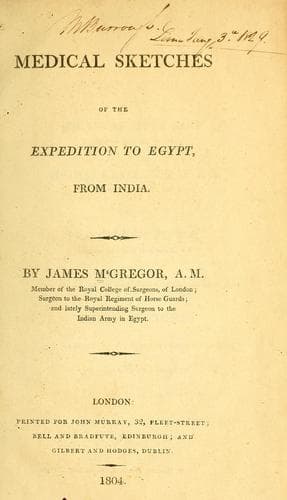
Medical Sketches of the Expedition to Egypt, from IndiaMcGrigor, James, Sir
History
Medical Sketches of the Expedition to Egypt, from India
McGrigor, James, Sir
Great Britain. Army -- Sanitary affairs; Medicine, Military
On the 15th, a private of the 8th light dragoons was shewn to me with a
bubo in his groin and giddiness, but without quickness of pulse or any
other febrile symptom. On being brought to Mr Price he was admitted into
the pest-house, and the treatment and result in him were similar to those
of Francis.
On the evening of the 15th, it being reported to me that a Sepoy had
suddenly died of fever in the line of the 7th Bombay regiment, I examined
the body, and found the inguinal glands swelled on both sides. About an
hour after, Mr Grisdale, the surgeon, shewed me a case in the hospital
of the same corps, which was evidently the plague, and which I instantly
ordered to the pest-house.
In the course of the month 38 more cases of the same disease, most
violent and rapid in their progress, appeared in the same regiment.
Three died, either in the hospital or on the lines, before they could be
conveyed to the pest-house, and one died in his way thither. One man of
the 1st Bombay regiment died of the same disease, who had clearly got the
contagion from the former corps, near which their hospital was situated.
The weather during the month was changeable; towards the end it was
boisterous. The thermometer in tents was sometimes so low as 49°, and
rarely rose above 70°. The sky was cloudy, but rain fell only once in
eight days. In the beginning of the month there was a considerable number
of cases of continued fever. There were fewer intermittents than in the
last month. The number of cases of dysentery was decreasing.
Towards the end of the month there were many cases of catarrh, pneumia,
and rheumatism. The diseases of the eyes were greatly on the decline. In
the weekly return of the 3d are three hundred and twelve cases, whereas
in that of the 31st there appear only ninety eight.
JANUARY, 1802.
With the exceptions already mentioned, all the army, during this month,
was in Alexandria, where they attained a degree of health they never had
at Rosetta. No case of the plague had been known at Alexandria when the
Indian army arrived there; and the strictest precautions were taken to
cut off the communication with Rosetta and the 7th regiment.
In the beginning of the month the weather was extremely boisterous: the
wind, generally from the north and north west, was very high. For eleven
days there was rain, and often very heavy. The thermometer was once
below 60°, and never above 70°, in a house in the centre of the city.
The number of sick was much smaller, but the mortality greater, than
in any preceding month. On the 1st, Mr Price, who was in charge of the
pest-house near Rosetta, was himself attacked with the disease, which
with him proved very violent.
On the following day, three of six Arabs, who acted as in-servants to the
pest-house near Rosetta, were also attacked.
On the 6th, a Sepoy of the 1st Bombay regiment died suddenly in the
hospital of the corps at Alexandria; the sick of this corps having
arrived from Rosetta but a few days before.
Public-domain text, read in full here on John Shaqi.
Reviews
Reviews
No reviews yet
Be the first to share your thoughts on this work.
Join the Discussion
Join the discussion
Sign in to leave a comment or review.
Sign InorCreate an account