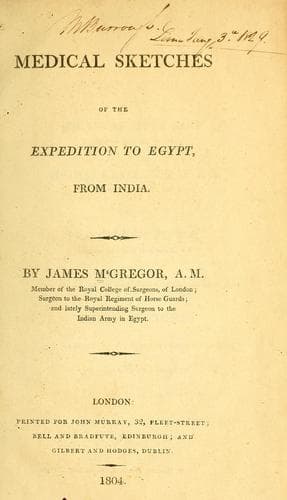
Medical Sketches of the Expedition to Egypt, from IndiaMcGrigor, James, Sir
History
Medical Sketches of the Expedition to Egypt, from India
McGrigor, James, Sir
Great Britain. Army -- Sanitary affairs; Medicine, Military
In the beginning of the month, the whole sick of the army amounted to
one thousand three hundred and fifty, or more than one-fourth part of
the whole strength of it. In the course of the month there appeared one
hundred and seventy cases of intermittent fever, occasioned evidently by
the effluvia from the low ground between the camp and the river, which
retained the rain, and, before we moved, became a swamp.
On the 8th, we were again alarmed at the appearance of a case of the
plague, in the department of the commissary of cattle, which was
immediately put under quarantine. On the 12th, symptoms of the disease
appeared in a Sepoy of the Bengal battalion, who was in the hospital of
that corps. On the 13th, five more cases were discovered in the same
hospital, which was ordered to be burnt, the sick having been removed
into a large house near Rosetta, where the same precautions were used as
with the 88th regiment, when the disease first broke out. After their
removal, no case appeared in that battalion. On the 12th a case of
small-pox was discovered in the hospital of the 10th regiment; and, in
the course of two days more, four cases appeared in the same hospital.
The first, a Portugueze servant, died. At the end of the month, the
number of sick was reduced. In the weekly return from the 20th to the
26th, there were six hundred and thirty-two Europeans, and three hundred
and eighty Sepoys, making a total of one thousand and twelve.
None of the tents kept the rain well out, which was often heavy. The
sand, however, quickly absorbed it in most places. The fever was, in
several instances, similar to a type, which we had been little used to,
viz. the typhoid.
DECEMBER.
Early in this month part of the army marched to Alexandria; and, by the
end of it, all the army, with the exception of the horse-artillery, 7th
Bombay regiment, and the department of the commissary of cattle, was
collected there. About the time that the first part of the army marched
thither, detachments of the 26th dragoons, and of Hompesch’s mounted
riflemen, joined us from the English army, and were quartered in Rosetta.
The plague now gained on us.
On the 1st of the month, Corporal Francis, of the 88th regiment, who had
been on the pest-house guard the day before, complained of slight febrile
symptoms and giddiness. He had a vibex on the seat of the inguinal
glands on one side, with some pain, but no swelling there. I shewed him
to Mr Price, who was in charge of the pest-house, and he had no doubt
of its being a case of the plague. Very soon after his admission into
the pest-house, a bubo appeared in his groin, and his fever increased.
Mercury was thrown in rapidly, his mouth became affected, and, the bubo
suppurating, he recovered.
Public-domain text, read in full here on John Shaqi.
Reviews
Reviews
No reviews yet
Be the first to share your thoughts on this work.
Join the Discussion
Join the discussion
Sign in to leave a comment or review.
Sign InorCreate an account