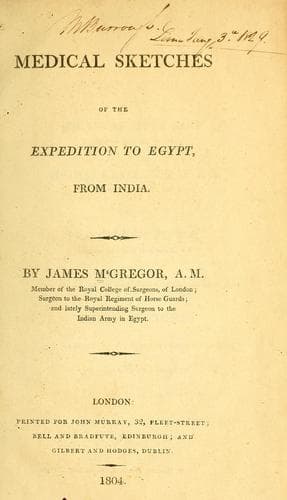
Medical Sketches of the Expedition to Egypt, from India — John Shaqi
Medical Sketches of the Expedition to Egypt, from IndiaMcGrigor, James, Sir
History
Medical Sketches of the Expedition to Egypt, from India
McGrigor, James, Sir
Great Britain. Army -- Sanitary affairs; Medicine, Military
On the 28th, Signior Positti, an Italian, came from Rosetta, and lodged
at the house of Mr Fantouchi, the Swedish consul in Alexandria. It was
discovered two days after that he had the plague, and he, with the
surgeon attending him, was immediately sent to the Lazaretto. Signior
Positti died on the day of his admission. Almost all the cases of plague,
which subsequently appeared in Alexandria, could be traced to this case
as a source.
The whole number of cases of plague, which occurred in the army during
this month, was only twenty one. Fever appeared in all the reports. It
was accompanied with the inflammatory diathesis, and it was in general
slight.
Of hepatitis and dysentery, the number of cases was still less than in
former months. Ulcers, which in the Indian army were hitherto very rarely
seen, prevailed at this period. Of rheumatism and pneumonia there was an
increase.
On the whole, in the course of the month, there was a decrease of
sickness, and a considerable decrease of the mortality. On the 1st of the
month there were seven hundred and five in the report; and on the 28th
only three hundred and twelve, or about one in twenty-six.
MARCH.
The weather was milder than in February. The thermometer was gradually
on the rise. During the month it never was lower than 50° nor higher
than 69°. The wind was most frequently from the west, from which quarter
it blew very strongly on the 13th, 14th, 15th, 16th, 19th, 20th, and
21st. It rained on 12 days; and on some of them, about the middle of the
month, very heavily. The atmosphere was in general cloudy. On the 19th we
had claps of loud thunder. But for the existence of the plague the army
might be said to have been very healthy during the month; and, though
this disease was more diffused through the country and in the army, yet
more cases did not occur in the Indian army than in last month, and the
mortality from this disease was much less considerable than formerly.
The garrison of Ghiza had been, for some time, the most healthy part of
the army. During the present month the corps there presented long reports
of sick. The small-pox broke out among the Sepoys there; and in the 86th
regiment there was an immense number of venereal cases, several of which,
from their standing, were inveterate.
The following is a list of the number sick of the plague in March.
Royal Artillery 1
— Navy 1
26th dragoons 9
10th regiment 2
61st regiment 7
88th regiment 2
1st Bombay regiment 1
7th ditto 8
The Departments 3
Foreign corps 3
Strangers 2
Arab servants 7
--
Total 46
--
Public-domain text, read in full here on John Shaqi.
Reviews
Reviews
No reviews yet
Be the first to share your thoughts on this work.
Join the Discussion
Join the discussion
Sign in to leave a comment or review.
Sign InorCreate an account