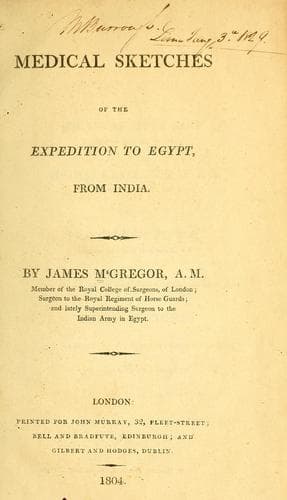
Medical Sketches of the Expedition to Egypt, from IndiaMcGrigor, James, Sir
History
Medical Sketches of the Expedition to Egypt, from India
McGrigor, James, Sir
Great Britain. Army -- Sanitary affairs; Medicine, Military
The women and children of the army, as well as some invalids, were here;
and they, with the Lascars of the fleet, were under the medical charge
of Dr Colquhoun and Mr Waring, whose reports had all along shewn a very
great degree of health. The only disease was the tropical dysentery,
and this was confined to the women and children, who were inactive. The
Lascars, who were actively employed, were all very healthy. During the
month, several cases of the plague were reported, but they were all very
mild. On the 4th, a Sepoy of the 1st Bombay regiment, on duty with the
pioneers in the desert, was attacked with the disease, and was the only
man who died of it during the month. On inquiry afterwards, it was found
that the Sepoy had got the infection from one of the interpreters, named
Peter, and that Peter brought the disease from the Turks in Cairo. The
case of the interpreter was so mild, that it was treated by Mr Dick as a
venereal complaint. He took mercury to produce salivation, the bubo came
to suppuration, and Peter recovered. As soon as the Sepoy died in the
desert, every article belonging to him was burnt with the body. A perfect
separation was effected, and every precaution taken in consequence. No
other case appeared in this detachment.
On the 12th, another case appeared in the 7th regiment, now encamped at
a village opposite Boulac. No plague could be discovered to have been in
the village. The occurrence of this case, therefore, could be accounted
for in no other way than that the seeds of the disease still lurked in
this very unfortunate corps, and that they brought it from Aboukir with
them. A pest-house was established under the charge of Dr Henderson at
Boulac, and two other mild cases were admitted into it towards the end of
the month.
On the 23d, the disease was discovered on a Madras tent-Lascar at Moses
Wells. On the 26th it was discovered on a serjeant of the 86th regiment
in crossing the desert. This was the last case which appeared previous to
the embarkation of the army.
The weather, during the month, was uncommonly fine. The thermometer
was greatly on the rise. During the month it was from 60° to 68°: at
Alexandria from 60° to 78°: in the tents on the desert, and at Moses
Wells, from 60° to 98°. The wind was generally from north to north-west.
In the desert, and at Moses Wells, we had the dry suffocating wind that
we found in the desert of Thebes, at Kossier, at the same time in the
former year; and the atmosphere was generally cloudy. The army was very
healthy.
Ophthalmia now, however, became a more frequent disease, particularly
among the Europeans, and it might be said to be the only disease which
prevailed.
JUNE.
Public-domain text, read in full here on John Shaqi.
Reviews
Reviews
No reviews yet
Be the first to share your thoughts on this work.
Join the Discussion
Join the discussion
Sign in to leave a comment or review.
Sign InorCreate an account