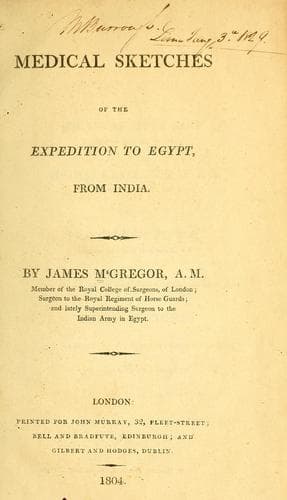
Medical Sketches of the Expedition to Egypt, from IndiaMcGrigor, James, Sir
History
Medical Sketches of the Expedition to Egypt, from India
McGrigor, James, Sir
Great Britain. Army -- Sanitary affairs; Medicine, Military
The departments (under which title are included about five hundred men
employed by the commissaries of cattle, of provisions, and of stores, and
by the quarter-master general) were, from beginning to end, more healthy
and had fewer deaths than any one corps in the army. They lost none but
from the plague; and, when this was discovered, such precautions were
taken that the contagion was very speedily eradicated. The extraordinary
health of this body of men, as well as their escape from the plague,
though particularly exposed to the contagion, I could only attribute to
the commissary of cattle, who had the greater part of them in his charge.
Captain Burr was constantly among these men, and was most singularly
attentive to every thing that regarded their internal economy.
I am decidedly of opinion, that in the peculiar soil and climate of Egypt
we are to look for the principal causes of the diseases which prevailed
the most in that country.
On grounds that appear not slight, we suspected that several of these
diseases were propagated by contagion. But I have no intention of
entering on the discussion of the theories of contagion; an obscure
subject, and on which I do not presume to think that I could throw
any new light. If ever the veil which covers it be removed, the late
discoveries in chemistry bid fair to do it. The accurate knowledge which
we have acquired of the composition of bodies, and in particular of the
constituent parts of the atmosphere, have opened new fields of inquiry
to the philosopher and to the physician. The successful application of
these discoveries to the practice of physic by the Doctors Beddoes and
Thornton, by Dr Rollo, Mr Cruickshank, Dr Wittman, and other eminent
surgeons of the artillery, and more particularly by the philanthropic Mr
Scott, of India, deserve the gratitude of the profession and of mankind
at large. Hereafter, most probably, and when introduced into general
practice, they will be looked upon as the greatest improvements that the
healing art has received in modern days.
In respect to the soil and climate of Egypt, as giving rise to disease,
they are of considerable variety. In a country of such extent, stretching
from the tropic, on the one side, to the shores of the Mediterranean, on
the other, this might be expected. If, in Lower Egypt, and on the bleak
shores of the Mediterranean, we saw the diseases of Europe, and met
with the inflammatory diathesis; in Upper Egypt, and as we approached
the tropic, we met with the same diseases, and succeeded with the same
treatment, as in the peninsula of India.
Perhaps no country is better known, or has been oftener described, than
Egypt. I therefore presume that every thing regarding the climate and
soil is generally known.
Public-domain text, read in full here on John Shaqi.
Reviews
Reviews
No reviews yet
Be the first to share your thoughts on this work.
Join the Discussion
Join the discussion
Sign in to leave a comment or review.
Sign InorCreate an account