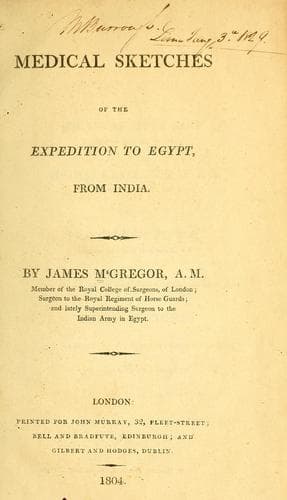
Medical Sketches of the Expedition to Egypt, from IndiaMcGrigor, James, Sir
History
Medical Sketches of the Expedition to Egypt, from India
McGrigor, James, Sir
Great Britain. Army -- Sanitary affairs; Medicine, Military
Upper Egypt, that is, the cultivated part of it, is a narrow stripe, laid
out sometimes on one and sometimes on both sides of the Nile, which,
in its course from Abyssinia till it passes Cairo, is on both sides
enchained with a ridge of mountains.
Lower Egypt is, in general, a fine, rich, flat, country, interspersed in
different places by branches of the Nile, and overflown by this river at
a particular season; at which time the country is in the situation of
Holland, or of the fenny counties of England.
The soil in most places is argillaceous or sandy, and in some calcareous;
but every where there is a strong mixture of a salt: in most places there
are incrustations of it to some depth. The quality of the atmosphere,
and the proportions of its different constituent parts, I regret that I
never had an opportunity of ascertaining.
The cultivated part of Egypt, particularly the Delta, is a very rich
country; in fertility and luxuriance of soil yielding to none under the
face of heaven. The art of husbandry is there but imperfectly known;
and at their harvests there is a very great destruction of vegetable
matter, from which hydrogene gas, or hydro-carbonate, is extricated in
great quantities. Under similar circumstances, in America as well as in
India, I have seen a bad fever of the intermittent or remittent type
appear. But in Egypt, after the subsiding of the Nile, which in many
places had covered a great extent of country, there is a great exhalation
from the mud, and from the putrid animal and vegetable matters left
behind. The effluvia of these substances, acting on the human body, will
readily account for much disease. If we add to these the extreme filth
of the inhabitants of Egypt, their poor diet, their narrow, close, and
ill-ventilated, apartments, generally much crouded, with the extreme
narrowness of their streets, and the bad police of their towns, we will
not be astonished if a fever, at first intermittent or remittent, should
have symptoms denominated malignant, superadded to the more ordinary
symptoms of the disease. If an imported contagion should make its
appearance at the same time, and under the above circumstances, we expect
a most terrible disease.
The dry parching wind, which comes over the desert, and which at certain
seasons blows in Egypt and in Arabia, is well known, and was often
severely felt by the army on their march, both across the desert and the
isthmus of Suez. The whirlwinds of sand roll with great impetuosity, are
very troublesome, and insinuate fine sand and dust every where. It is
hardly possible to keep the minute particles out of the eyes.
Public-domain text, read in full here on John Shaqi.
Reviews
Reviews
No reviews yet
Be the first to share your thoughts on this work.
Join the Discussion
Join the discussion
Sign in to leave a comment or review.
Sign InorCreate an account