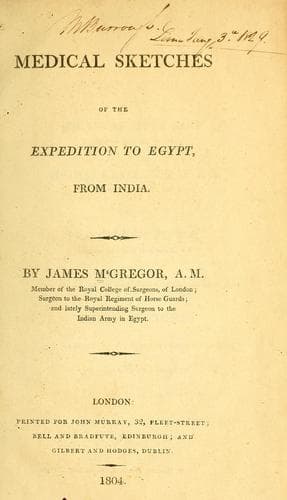
Medical Sketches of the Expedition to Egypt, from IndiaMcGrigor, James, Sir
History
Medical Sketches of the Expedition to Egypt, from India
McGrigor, James, Sir
Great Britain. Army -- Sanitary affairs; Medicine, Military
The dews, which fall in Egypt, I always heard were very heavy, and were
a cause of the diseases of the country. I had occasion too, more than
once, to hear the natives attribute much to them as the cause of their
diseases; with what justice I will not pretend to decide. From some
experiments which I made in India, on the Red Sea, and lastly in Egypt,
I am inclined to think that they are equally heavy in the two former as
in the latter quarter. After weighing it carefully, I took a piece of
lint, twelve inches square, exposed it for a night to the dew, and, by
weighing it in the morning again, ascertained the quantity which it had
gained. I am aware that this is by no means a nice experiment, and that
in the performance of it several particulars demand attention; but it is
sufficient to our purpose, and I learned by it, that, in the island of
Bombay, on the Red Sea, and in Lower Egypt, the quantity of dew which
falls is nearly equal.
It ought to be mentioned, that, during the year we were in Egypt, the
season was not the usual one. There was a greater overflow of the Nile.
It rose higher on the Nilometer than it had done for several former
years, and it was remarked to be much later in subsiding at Rosetta.
The fall of rain at Alexandria was greater than on former years; and, at
Rosetta, the rains were in setting in later than usual. The season of the
plague set in much earlier than usual.[2]
In general, the Thebaid, or Upper Egypt, is healthier than the Lower.
Never were troops more healthy than the army when encamped near Ghenné.
Ghiza, the ancient Memphis, at the time the army disembarked there from
Upper Egypt, we found to be a very unhealthy quarter. For a considerable
time, and immediately before the arrival of the Indian army, it had been
the station of large armies: alternately of Turks, Mamelukes, French, and
English. From all these armies a number died at Ghiza, and there was much
filth and noxious effluvia. We saw there enough of putrid animal matter
to generate contagion. Whether this was or was not the cause of the fever
which prevailed, I will not attempt to decide. One circumstance may be
mentioned. We were here joined by a detachment of the 86th regiment under
Colonel Lloyd, which, for some months before, had been doing duty with
the Vizier’s army, which never was healthy. That the circumstances which
existed at the time of our occupying Ghiza were the cause of the fever is
manifest from this, that, subsequently to the army going to the coast,
the garrison left in it found Ghiza a most healthy quarter. The same
objections are to be made to Rhoda that are applicable to any marshy
situation.
The 86th regiment found Damietta healthy, till the Turkish troops came
down in great numbers from Cairo; but, at this period, the British troops
were removed from it.
Public-domain text, read in full here on John Shaqi.
Reviews
Reviews
No reviews yet
Be the first to share your thoughts on this work.
Join the Discussion
Join the discussion
Sign in to leave a comment or review.
Sign InorCreate an account