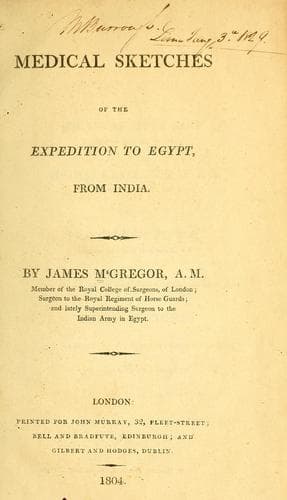
Medical Sketches of the Expedition to Egypt, from IndiaMcGrigor, James, Sir
History
Medical Sketches of the Expedition to Egypt, from India
McGrigor, James, Sir
Great Britain. Army -- Sanitary affairs; Medicine, Military
The horse-artillery and 8th dragoons were, along with the 26th dragoons,
stationed at Damenhoure, which had every advantage of a country quarter.
It was situated in a fine, open, cultivated, country. The station was
thought so good, that at last we sent the sick of the army to this
quarter; and old cases of dysentery and hepatitis, as well as some
of fever, recovered here with astonishing rapidity. By the time of
their arrival there was in many a great amendment. They were conveyed
in waggons constructed for them, and made three days easy journey to
Damenhoure.
In the difference of Upper Egypt in June, and El Hammed and Rosetta in
December, is included perhaps more than change of season; there was
change of climate and of heat from 108° to 49° of the thermometer. We
have said that, in many instances, the causes of disease at El Hammed
could be traced to the march across the desert and the encampment at
Rhoda. Very much, however, was likewise to be attributed to the change of
weather experienced in November and December.
In every part of the world, with change of season, some diseases pretty
constantly make their appearance; but in no part is this so observable as
in the countries under the tropics. In the West-Indian islands, as well
as on the shores of India, I have repeatedly and uniformly observed the
sick-list of European corps more than doubled by the third week after
the setting in of the monsoon.[3] In these countries a very considerable
increase of sick is likewise found to take place on the change from the
rainy to the dry season. The change of season in Egypt had nearly an
equal influence on the health of the army while there.
In a memoir, which, four years ago, I had occasion to present to the
Military and Medical Boards at Bombay, on the state of health of the
88th regiment, and of detachments of the 75th, 77th, 84th, and 86th,
regiments, under my care, one passage is so very closely applicable to
the subject I am now on, that I will extract it. After pointing out the
smaller proportion of sickness in different corps, and in proportion as
they had been in India from one, two, three, to twenty, years, and the
very great proportion of disease and mortality which the European bore to
the native Indian corps, the memoir goes on:
“Though, perhaps, a residence for a certain length of time, or a
naturalisation to the climate, be necessary, yet one reason may, with
probability, be brought forward to account for the very great difference,
in point of health, between European and Indian corps, viz. the great
intemperance of the European in eating and drinking. A native of India is
astonished, at first, to see the meals of animal food devoured, and the
quantity of spirits drank, by Europeans. There can be little doubt, that
the nearer we approach to the mode of living of the natives, the more
nearly we shall attain their state of health.
Public-domain text, read in full here on John Shaqi.
Reviews
Reviews
No reviews yet
Be the first to share your thoughts on this work.
Join the Discussion
Join the discussion
Sign in to leave a comment or review.
Sign InorCreate an account