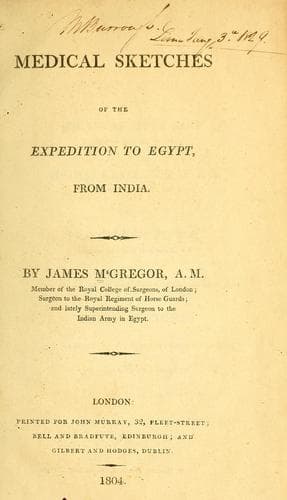
Medical Sketches of the Expedition to Egypt, from IndiaMcGrigor, James, Sir
History
Medical Sketches of the Expedition to Egypt, from India
McGrigor, James, Sir
Great Britain. Army -- Sanitary affairs; Medicine, Military
On the 24th of December, one of the Arab servants, convalescent from the
disease, and who had been convalescent for eight days, taking bark, while
smoking his pipe suddenly expired. In no disease do patients bear motion
worse than in this. The least motion[5] induced syncope or death.
Sometimes, they who had for some time been convalescent, suddenly
complained that they felt giddy, and expired. Sometimes they called for
food, and expired with it in their mouths. In one of Mr Adrian’s cases,
where the fever had for some time been gone, and the patient was so far
convalescent that he daily walked about a quarter of a mile, the man
suddenly complained of giddiness, and expired in ten minutes.
Mr Thomas had two cases where, after affecting their gums, there was a
complete apyrexia: but he lost his patients from an immense discharge
from the glands and from a secondary fever. In general, it was found,
that the patient recovered in proportion to the facility with which his
gums and skin could be affected.
The _prognosis_ likewise depended much on the degree of the affection of
the sensorium; when the patient was from the beginning comatose, the
case terminated fatally. Several of the cases in the beginning of the
season, particularly the natives of India, could never be roused. The
typhomania was a more fatal delirium than the inflammatory species.
In the _treatment_ of this disease, a variety of modes were put in
practice; but so little success attended them, that some were inclined to
despair of success from any. Though, with it, even many were lost, yet
oxygenation and particularly the use of mercury had the most success.
Though every thing was done by General Baird that the situation and
circumstances allowed, yet the gentlemen in the pest-houses laboured
under so many disadvantages, that, for the most part, there was but
little to be expected from any mode of treatment. In particular, not
a little difficulty, as well as danger, was met with in affecting the
gums. Safety required that the pest-houses should be at some distance;
perhaps, in general, the distance at which they were placed was too
great. The patient suffered much by the conveyance, and frequently the
treatment of the disease was entered on at too late a period to promise
success. In December, January, February, and March, patients suffered so
much from the extreme severity of the weather, that in some instances it
was not easy to determine whether a patient died from cold or from the
plague.
So much dejection prevailed among the natives of India, that, from the
moment of the attack, they gave themselves up, and said they were sent to
the pest-house to die. They never could be prevailed upon to swallow a
morsel of food nor any medicine, and some actually starved themselves.
With establishments of a proper structure, and under proper regulations,
we may safely venture to affirm, that our loss from the plague in Egypt
would not have been half of what it was.
Public-domain text, read in full here on John Shaqi.
Reviews
Reviews
No reviews yet
Be the first to share your thoughts on this work.
Elsewhere in the archive
Join the Discussion
Join the discussion
Sign in to leave a comment or review.
Sign InorCreate an account