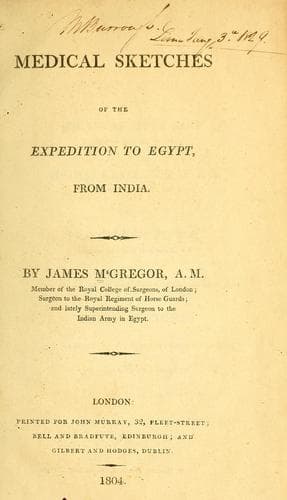
Medical Sketches of the Expedition to Egypt, from IndiaMcGrigor, James, Sir
History
Medical Sketches of the Expedition to Egypt, from India
McGrigor, James, Sir
Great Britain. Army -- Sanitary affairs; Medicine, Military
It has sometimes occurred to myself, and I have
frequently had reports from our surgeons, that agues continued obstinate
till the gums could be affected by mercury.
From a very intelligent officer I had a detail, regarding the Batavia
fever, so remarkable, that I shall here insert it. This gentleman is
the captain of a ship in India, who, in different voyages which he had
made to Batavia, had constantly lost great numbers of his ship’s crews.
In his last voyage, when in a certain latitude, and as he approached
Batavia, he gave daily to each of his men a few grains of the mass of the
blue pill. By the time of his arrival at Batavia, he had thus very gently
affected every one of their mouths; and, in that voyage, he lost not a
man. Would mercury thus exhibited, as a preventive, be useful in the
plague, or in the yellow fever?
Before dismissing the subject of fever I may observe that no well-marked
case of typhus occurred to us in Egypt. In India we never saw a case of
this species of fever. To the existence of this fever, which in Europe
has committed such havoc in our fleets and armies, the climate of India
is inimical. We know instances where, in transports, typhus had broke
out, and, on the passage to the Cape of Good Hope or India, had proved
little less destructive than the plague could have done; but the disease
never reached India. If a case was landed there, it never propagated the
contagion: a second case never appeared on shore. On inquiry, I found
that no case had ever been known on the western side of the peninsula,
nor have I ever heard of its existence in the eastern.
HEPATITIS, OR THE LIVER COMPLAINT.
In India I have often had occasion to remark, that the acute hepatitis,
of Cullen, was a disease of rare occurrence. The disease which comes
before us most frequently, in India, is his chronic species; and in that,
most frequently, there is neither pyrexia nor the “decubitus in latus
sinistrum difficilis,” which, from having included in the definition of
both of his species, I suppose the illustrious and accurate professor was
induced to believe was a constant symptom in this disease. In very few of
his definitions is there room for alteration; and I hope, for venturing
here to suggest one, that I shall not incur the charge of presumption.
But hepatitis was a disease, for accounts of which the accurate
nosologist must have trusted to other sources than his own observation.
It should be known, that very often we meet with this disease, when few
of the symptoms of his definition are found. In India I have learned from
some of the oldest practitioners, and from some gentlemen of abilities,
the most respectable in the profession, that very commonly hepatitis is
met with when all the symptoms of Cullen’s definition are wanting. In
that country, when any of the abdominal viscera are complained of, we may
in general suspect some error in the hepatic system.
Public-domain text, read in full here on John Shaqi.
Reviews
Reviews
No reviews yet
Be the first to share your thoughts on this work.
Elsewhere in the archive
Join the Discussion
Join the discussion
Sign in to leave a comment or review.
Sign InorCreate an account