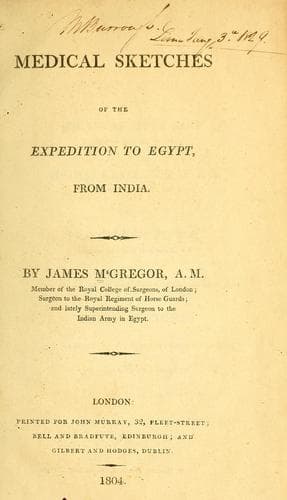
Medical Sketches of the Expedition to Egypt, from IndiaMcGrigor, James, Sir
History
Medical Sketches of the Expedition to Egypt, from India
McGrigor, James, Sir
Great Britain. Army -- Sanitary affairs; Medicine, Military
On the 19th, the 88th, with two companies of the 80th regiment, under the
command of Colonel Beresford, as the advance of the army, commenced the
march across the desert. Having the digging of wells and other duties to
perform, the advance did not reach the banks of the Nile until the next
month. The rest of the army marched on the following days, the marches
being always performed by night; and the army, with a very inconsiderable
loss, reached the banks of the Nile in a very healthy state. The course
which we took was nearly that travelled by Mr Bruce. For a considerable
way after we left Kossier, the road had the strongest resemblance to the
bed of a river. As we advanced from Kossier, the water became daily less
salt, and less bitter. At Le Gita, and at Bir Amber, the two stations
nearest to Ghenné, it was not much complained of.
The winds in Kossier camp, from nine to twelve o’clock, generally blew
from the N. W. accompanied with torrents of sand.
On the march, a very hot suffocating wind from the W. set in about ten
and continued till three o’clock. The thermometer at Kossier could not be
attended to.
On the 29th, at Le Gita, in my tent, at three P. M. the mercury stood at
114°. In the soldiers tents it could not have been less than 118°. At
six o’clock in the morning, in a well three feet deep, it was at 69°;
and, after taking it out, it fell to 63°: but evaporation must have had
a share in the reduction. In other places, on the march, the degree of
heat must have been higher. Le Gita is not a situation favourable to the
centration of heat: it is situated in a large open plain of many miles
extent.
There was but little sickness in this month, and yet almost every
exciting cause existed. The heat was intense. In the currents of dust,
much of it went into the stomach and lungs, and occasioned nausea, which
was likewise occasioned by the destructive hot wind. To this the Arabs
and even the camels always turn their backs. The men were frequently
exercised, and the duties of fatigue in India, usually done by black
natives, were performed at Kossier by the soldiers. The fatigue on the
march has perhaps never been exceeded in any army. Diarrhœa, and a few
cases of ophthalmia, and nyctalopia, were the only diseases in the army.
The native corps from Bombay were recovering from a fever, with which
they landed. These corps were the last that crossed the desert.
JULY.
Public-domain text, read in full here on John Shaqi.
Reviews
Reviews
No reviews yet
Be the first to share your thoughts on this work.
Join the Discussion
Join the discussion
Sign in to leave a comment or review.
Sign InorCreate an account