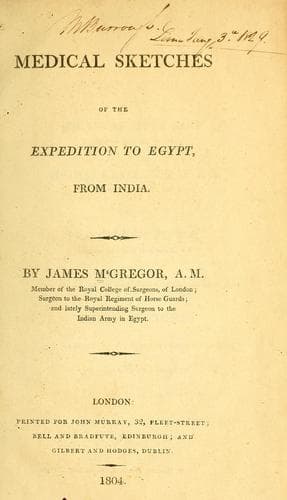
Medical Sketches of the Expedition to Egypt, from IndiaMcGrigor, James, Sir
History
Medical Sketches of the Expedition to Egypt, from India
McGrigor, James, Sir
Great Britain. Army -- Sanitary affairs; Medicine, Military
During almost the whole of this month, the army was encamped on the banks
of the Nile, which now began to overflow its banks, near Ghenné. On the
opposite bank are the magnificent ruins of Tentyra, or Dendira, and the
fine temple of Isis. The situation of the army near Ghenné was very
healthy. There was excellent water, and an abundant market of vegetables,
of fruit, and of the best provisions. We prepared to move, and
detachments of the army went up to Thebes, Luxor, and to the cataracts,
to press all the boats. About the end of the month, the army began to
move to Lower Egypt. The 10th regiment marched to Girgé, the capital of
Upper Egypt, sixty miles below Ghenné.
On the 27th and following days, the rest of the army was embarked in
boats. The wind at Ghenné was not regular from any quarter, and sand was
blown from all quarters, particularly at the time of the springs. The
thermometer had a wide range at Ghenné. In my marquee from 71° to 108°.
On the 20th, it rose to 110°. In the open air the heat was from 70°
to 115°. There was more sickness than in the last month. There were
several cases of hepatitis, particularly in the 10th regiment, and cases
of dysentery were not unfrequent towards the end of the month. In the
beginning a considerable number of cases of fever appeared, and not a few
of ophthalmia and pneumonia: but all these soon did well, after being
removed to a good hospital. The Catchief, the officer next in rank to the
Bey, gave up his own house for an hospital, and General Baird likewise
gave up his quarters to the sick.
AUGUST.
By the 12th of this month, the greater part of the army, after a
navigation of the Nile, of nearly four hundred miles, arrived at
Damietta, where we found one regiment of the English army, the 89th, and
a general hospital, under charge of Dr Franks, the inspector. The troops
at first were put into quarters there; but an encampment was afterwards
formed on Rhoda, a small island made by the Nile, very nearly in the
centre between Cairo and Ghiza. The Nilometer is on this island. As they
landed, the troops were uncommonly healthy. Most of the hepatic and
dysenteric sick had recovered on the passage, and the only disease with
which they landed was slight fever, of which the cases were not numerous.
This state of health continued but a very short time after the landing.
In the course of the first week, most of the corps sent one-twelfth and
some one-tenth of their strength to the hospital.
Public-domain text, read in full here on John Shaqi.
Reviews
Reviews
No reviews yet
Be the first to share your thoughts on this work.
Join the Discussion
Join the discussion
Sign in to leave a comment or review.
Sign InorCreate an account