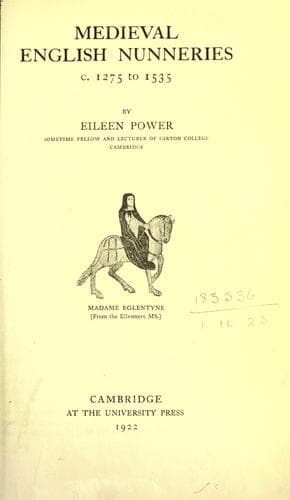
Medieval English Nunneries c. 1275 to 1535 — John Shaqi
Medieval English Nunneries c. 1275 to 1535Power, Eileen
History
Medieval English Nunneries c. 1275 to 1535
Power, Eileen
Convents -- England; Monastic and religious life of women -- History
There were in England during the later middle ages (c. 1270-1536) some 138
nunneries, excluding double houses of the Gilbertine order, which
contained brothers as well as nuns. Of these over one half belonged to the
Benedictine order and about a quarter (localised almost entirely in
Lincolnshire and Yorkshire) to the Cistercian order. The rest were
distributed as follows: 17 to the order of St Augustine and one (Minchin
Buckland), which belonged to the order of St John of Jerusalem and
followed the Austin rule, four to the Franciscan order, two to the Cluniac
order, two to the Premonstratensian order and one to the Dominican order.
There was also founded in the fifteenth century a very famous double house
of the Brigittine order, Syon Abbey. Twenty-one of these houses had the
status of abbeys; the rest were priories. They were distributed all over
the country, Surrey, Lancashire, Westmorland and Cornwall being the only
counties without one, but they were more thickly spread over the eastern
than over the western half of the island. They were most numerous in the
North, East and East Midlands, to wit, in the dioceses of York, Lincoln
(which was then very large and included Lincolnshire, Northamptonshire,
Rutland, Bedfordshire, Huntingdonshire, Leicestershire, Buckinghamshire,
Oxfordshire and part of Hertfordshire) and Norwich; there were 27 houses
in the diocese of York, 31 in the diocese of Lincoln, ten in the diocese
of Norwich and in London and its suburbs there were seven. On the other
hand if nunneries were most plentiful in the North and East Midlands it
was there that they were smallest and poorest. The wealthiest and most
famous nunneries in England were all south of the Thames. Apart from the
new foundation at Syon, which very soon became the largest and richest of
all, the greatest houses were the old established abbeys of Wessex,
Shaftesbury, Wilton, St Mary's Winchester, Romsey and Wherwell, which,
together with Barking in Essex were all of Anglo-Saxon foundation; and
Dartford in Kent, founded by Edward III. The only houses north of the
Thames which approached these in importance were Godstow and Elstow
Abbeys, in Oxfordshire and Bedfordshire respectively; the majority were
small priories with small incomes.
Public-domain text, read in full here on John Shaqi.
Reviews
Reviews
No reviews yet
Be the first to share your thoughts on this work.
Join the Discussion
Join the discussion
Sign in to leave a comment or review.
Sign InorCreate an account