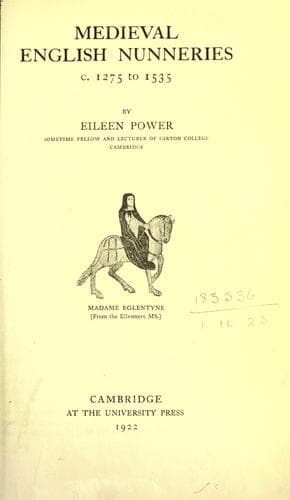
Medieval English Nunneries c. 1275 to 1535Power, Eileen
History
Medieval English Nunneries c. 1275 to 1535
Power, Eileen
Convents -- England; Monastic and religious life of women -- History
An analysis of the incomes and numerical size of English nunneries at the
dissolution gives interesting and somewhat startling results. Out of 106
houses for which information is available only seven had in 1535 a gross
annual income of over L450 a year. The richest were Syon and Shaftesbury
with L1943 and L1324 respectively; then came Barking with L862, Wilton
with L674, Amesbury with L595, Romsey with L528 and Dartford with L488.
Five others (St Helen's Bishopsgate, Haliwell and the Minories all in
London, Elstow and Godstow) had from L300 to L400; nine others (Nuneaton,
Clerkenwell, Malling, St Mary's Winchester, Tarrant Keynes, Canonsleigh,
Campsey, Minchin Buckland and Lacock) had from L200 to L300. Twelve had
between L100 and L200 and no less than 73 houses had under L100, of which
39 actually had under L50; and it must be remembered that the net annual
income, after the deduction of certain annual charges, was less still[1].
An analysis of the numerical size of nunneries presents more difficulties,
for the number of nuns given sometimes differs in the reports referring to
the same house and it is doubtful whether commissioners or receivers
always set down the total number of nuns present at the visitation or
dissolution of a house; while lists of pensions paid by the crown to
ex-inmates after dissolution are still more incomplete as evidence. A
rough analysis, however, leaves very much the same impression as an
analysis of incomes[2]. Out of 111 houses, for which some sort of
numerical estimate is possible, only four have over thirty inmates, viz.
Syon (51), Amesbury (33), Wilton (32) and Barking (30). Eight (Elstow, the
Minories, Nuneaton, Denny, Romsey, Wherwell, Dartford and St Mary's
Winchester) have from 20 to 30; thirty-six have from 10 to 20 and
sixty-three have under 10. These statistics permit of certain large
generalisations. First, that the majority of English nunneries were small
and poor. Secondly, that, as has already been pointed out, the largest and
richest houses were all in London and south of the Thames; only four
houses north of that river had gross incomes of over L200 and only three
could boast of more than 20 inmates. Thirdly, the nunneries during this
period owned land and rents to the annual value of over L15,500 and
contained perhaps between 1500 and 2000 nuns.
To understand the history of the English nunneries during the later middle
ages it is necessary not only to understand the smallness and poverty of
many of the houses and the high repute of others; it is necessary also to
understand what manner of women took the veil in them. From what social
classes were the nuns drawn, and for what reason did they enter religion?
What function did monasticism, so far as it concerned women, fulfil in
the life of medieval society?
Public-domain text, read in full here on John Shaqi.
Reviews
Reviews
No reviews yet
Be the first to share your thoughts on this work.
Join the Discussion
Join the discussion
Sign in to leave a comment or review.
Sign InorCreate an account