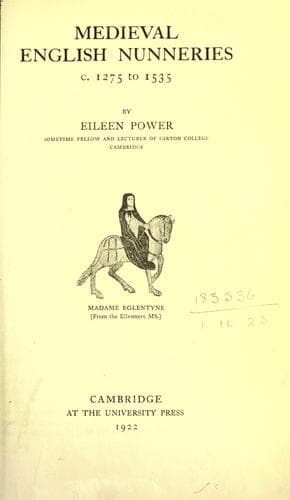
Medieval English Nunneries c. 1275 to 1535Power, Eileen
History
Medieval English Nunneries c. 1275 to 1535
Power, Eileen
Convents -- England; Monastic and religious life of women -- History
The relations between the nuns and their priest were doubtless very
friendly; he would be their guide, philosopher and friend, sometimes
acting as _custos_ of their temporal affairs and always ready with advice.
Madame Eglentyne, it will be remembered, took three priests with her upon
her eventful pilgrimage to Canterbury, and one was the
never-to-be-forgotten Sir John, whom she mounted worse than his inimitable
skill as a _raconteur_ deserved:
Than spak our host, with rude speche and bold
And seyde un-to the Nonnes Preest anon,
"Com neer, thou preest, com hider thou sir John,
Tel us swich thing as may our hertes glade,
Be blythe, though thou ryde up-on a jade.
What though thyn hors be bothe foule and lene,
If he wol serve thee, rekke not a bene;
Look that thyn herte be mery evermo."
"Yis, sir" quod he, "yis, host, so mote I go,
But I be mery, y-wis I wol be blamed":--
And right anon his tale he hath attamed,
And thus he seyde unto us everichon,
This swete preest, this goodly man, sir John[393].
Certainly the convent never went to sleep in a sermon which had the tale
of Chauntecleer and Pertelote for its _exemplum_.
Yet the nuns were not always happy in their priests. There is the case
(not, it must be admitted, without its humour) of Sir Henry, the chaplain
of Gracedieu in 1440-41. Sir Henry was an uncouth fellow, it seems, who
was more at home in the stable than at the altar. He went out haymaking
alone with the cellaress, and in the evening brought her back behind him,
riding on the same lean jade. Furthermore "Sir Henry the chaplain busies
himself with unseemly tasks, cleansing the stables, and goes to the altar
without washing, staining his vestments. He is without devotion and
irreverent at the altar and is of ill reputation at Loughborough and
elsewhere where he has dwelt." Poor Sir Henry,--
See, whiche braunes hath this gentil Preest,
So greet a nekke, and swich a large breest!
He loketh as a sperhauk with his yen;
Him nedeth nat his colour for to dyen
With brasil, ne with greyn of Portingale.
The bishop swore him to "behave himself devoutly and reverently
henceforward at the altar in making his bow after and before his
masses"[394].
Public-domain text, read in full here on John Shaqi.
Reviews
Reviews
No reviews yet
Be the first to share your thoughts on this work.
Elsewhere in the archive
Join the Discussion
Join the discussion
Sign in to leave a comment or review.
Sign InorCreate an account