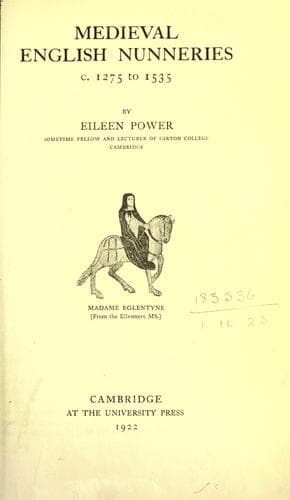
Medieval English Nunneries c. 1275 to 1535Power, Eileen
History
Medieval English Nunneries c. 1275 to 1535
Power, Eileen
Convents -- England; Monastic and religious life of women -- History
Sometimes also a servant would act as a go-between
between the nuns and the outside world, smuggling in and out tokens and
messages and sundry _billets doux_[429].
On the other hand there were sometimes difficulties of a different nature.
The servants got out of hand; they brought discredit on the nuns by the
indiscretions of their lives; they gossiped about their mistresses in the
neighbourhood, or were quarrelsome and pert to their faces. At Gracedieu
in 1440-41 a nun complained "that a Frenchwoman of very unseemly
conversation is their maltstress, also that the secular serving folk hold
the nuns in despite; she prays that they may be restrained; and chiefly
are they rebellious in their words against the kitchener"[430]; evidently
the author of the _Ancren Riwle_ spake not utterly from his imagination
when he bade his ladies "be glad in your heart if ye suffer insolence from
Slurry, the cook's boy, who washeth dishes in the kitchen"[431]. At
Markyate also the servants had to be warned "that honestly and not
sturdyly ne rebukyngly thai hafe thaym in thaire langage to the
sustres"[432] and at Studley a maidservant had boxed the ears of a novice
of tender age[433]. At Sheppey in 1511 it was said that "the men servants
of the prioress do not behave properly to the prioress, but speak of the
convent contemptuously and dishonestly, thus ruining the convent"[434].
The peculiar difficulties suffered in this respect by an important house,
which maintained a large body of servants, are best illustrated, however,
in the case of Romsey Abbey. At this house in 1302 Bishop John of Pontoise
ordained
that a useless, superfluous, quarrelsome and incontinent servant and
one using insolent language to the ladies shall be removed within a
month, ... and especially John Chark, who has often spoken ill and
contumaciously in speaking to and answering the ladies, unless he
correct himself so that no more complaints be made to the bishop[435].
John Chark possibly learned to bridle his tongue, but the tone among the
Romsey servants was not good, for in 1311 Bishop Henry Woodlock ordered
that "no women servants shall remain unless of good conversation and
honest; pregnant, incontinent, quarrelsome women and those answering the
nuns contumaciously, all superfluous and useless servants, [are] to be
removed within a month"[436]. In 1387 the difficulties were of another
order; writes William of Wykeham:
Public-domain text, read in full here on John Shaqi.
Reviews
Reviews
No reviews yet
Be the first to share your thoughts on this work.
Elsewhere in the archive
Join the Discussion
Join the discussion
Sign in to leave a comment or review.
Sign InorCreate an account