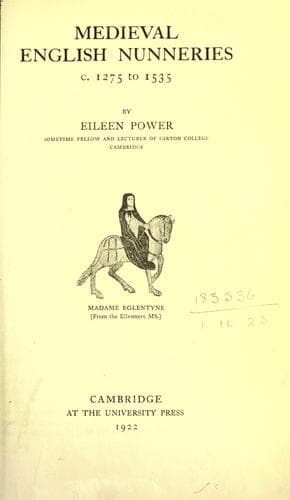
Medieval English Nunneries c. 1275 to 1535Power, Eileen
History
Medieval English Nunneries c. 1275 to 1535
Power, Eileen
Convents -- England; Monastic and religious life of women -- History
nobility of her race"; an old lady of firm will and (despite his careful
mention of extra pittances and of tolerating for a while) a somewhat
sycophantic prelate[21].
It is worthy of notice that Chaucer has drawn an unmistakable "lady" in
his typical prioress. There is her delicate behaviour at meals:
At mete wel ytaught was she with-alle;
She leet no morsel from her lippes falle,
Ne wette hir fingres in hir sauce depe.
Wel coude she carie a morsel, and wel kepe,
That no drope ne fille upon hir brest.
In curteisye was set ful muche hir lest.
Hir over lippe wyped she so clene,
That in hir coppe was no ferthing sene
Of grece, whan she drunken hadde hir draughte.
Ful semely after hir mete she raughte[22].
This was the _ne plus ultra_ of feudal table manners; Chaucer might have
been writing one of those books of deportment for the guidance of
aristocratic young women, which were so numerous in France. So the _Clef
d'Amors_ counsels ladies who would win them lovers[23], and even so Robert
de Blois depicts the perfect diner. Robert de Blois' ideal, the
chivalrous, frivolous, sensuous ideal of "courtesy," which underlay the
whole aristocratic conception of life and the attainment of which was the
criterion of polite society, is the ideal of the Prioress also:
"Gardez vous, Dames, bien acertes,"
"Qu'au mengier soiez bien apertes;
C'est une chose c'on moult prise
Que la soit dame bien aprise.
Tel chose torne a vilonie
Que toutes genz ne sevent mie;
Se puet cil tost avoir mespris
Qui n'est cortoisement apris[24]."
Later he warns against the greedy selection of the finest and largest
titbit for oneself, on the ground that "n'est pas _cortoisie_." The same
consideration preoccupies Madame Eglentyne at her supper: "in _curteisye_
was set ful muche hir lest." Good manners, elegant deportment, the polish
of the court, all that we mean by nurture, these are her aim:
And sikerly she was of greet disport,
And ful plesaunt, and amiable of port,
And peyned her to countrefete chere
Of court, and been estatlich of manere,
And to be holden digne of reverence.
Her pets are the pets of ladies in metrical romances and in illuminated
borders; "smale houndes," delicately fed with "rosted flesh, or milk and
wastel-bread." Her very beauty
(Hir nose tretys; hir eyen greye as glas,
Hir mouth ful smal, and ther-to soft and reed;
But sikerly she hadde a fair forheed;
It was almost a spanne brood, I trowe;
For, hardily, she was nat undergrowe)
conforms to the courtly standard. Only the mention of her chanting of
divine service (through the tretys nose) differentiates her from any other
well-born lady of the day; and if Chaucer had not told us whom he was
describing, we might never have known that she was a nun. It was in these
ideals and traditions that most of the inmates of English convents were
born and bred.
Public-domain text, read in full here on John Shaqi.
Reviews
Reviews
No reviews yet
Be the first to share your thoughts on this work.
Join the Discussion
Join the discussion
Sign in to leave a comment or review.
Sign InorCreate an account